
Importance of Trade Series: Ethanol

Lyndi Allen
July 3, 2025

Part Three: Fueling Global Markets, Supporting Illinois Farms

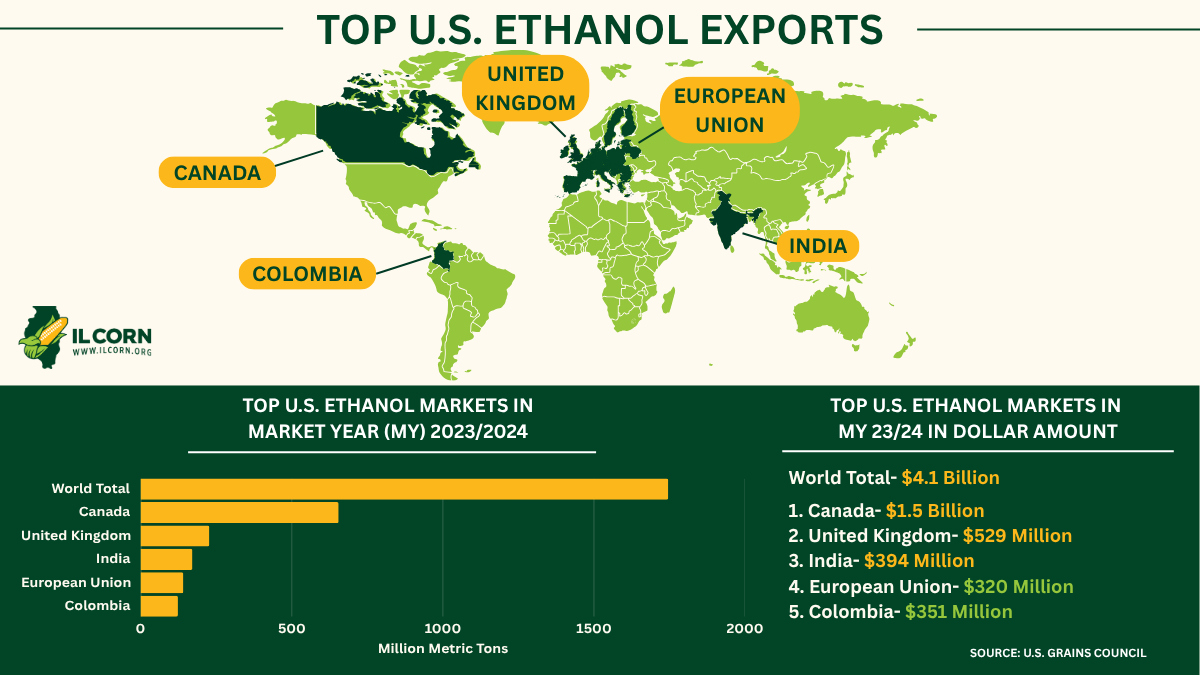
World map showing top U.S. ethanol export destinations: Canada, U.K., European Union, Mexico, and others. Bar graph included.

Trade plays a critical role in driving demand for U.S. corn—not only as grain or feed, but also as fuel. Ethanol is a vital export for Illinois corn farmers as 28 percent of the corn grown in Illinois goes to ethanol. Some of that ethanol is shipped to countries around the world looking for affordable, lower-carbon fuel options.


Illinois is home to the largest dry mill ethanol plant in the world, Marquis Energy in Hennepin, IL. Marquis Energy produces more than 395 million gallons of high-octane, high-performance renewable fuel per year, as well as Distillers Dried Grains with Solubles (DDGS) and Distillers Corn Oil. This plant is located right on the Illinois river, exporting ethanol globally.


In the 2023/2024 market year (MY), U.S. ethanol exports totaled 1.7 billion gallons, shipping to more than 75 countries.


Top U.S. Ethanol Markets

1.     Canada

·        655 million gallons

·        $1.5 billion

2.     United Kingdom

·        227 million gallons

·        $529 billion

3.     India

·        171 million gallons

·        $394 billion


Trade remains essential for Illinois corn farmers to grow demand and markets. IL Corn supports international trade and trade policies that grow opportunities for U.S. corn ethanol.

staff at Topflight
By Tara Desmond March 12, 2026
Meet Julie Day in our Inside the Elevator series as she shares her journey to TopFlight Grain and what it takes to handle 42 million bushels during harvest.
Clint
By Tara Desmond & Clint Gorden March 12, 2026
Illinois farmer Clint Gorden shares how using wheat as both a cover crop and cash crop helps improve soil health, support wildlife and still make conservation pay.
AI on the farm
By Tara Desmond March 12, 2026
AI is transforming agriculture from autonomous tractors to crop AI tools but farmers remain essential to the future of ag.
Kate Pink Hat Farmer
By Tara Desmond March 12, 2026
For the woman known online as the Pink Hat Farmer , the road back to the family farm wasn’t always obvious. A sixth-generation farmer from Galva and Kewanee, Illinois, she grew up surrounded by agriculture but also the realities that come with it. As a child, she watched her family navigate difficult times in the industry, including the stress of the 1990s hog crisis. Seeing that pressure firsthand made her question whether farming was the life she wanted. After graduating from the University of Illinois, she moved to the Chicago suburbs and tried building a life away from agriculture. But it didn’t take long to realize something was missing. “I lasted nine months,” she says. “I love to visit my friends up there. But that lifestyle wasn’t for me.” What she missed most was the rhythm of farm life - being able to step outside, work on a piece of machinery, and reset her mindset in the quiet of the countryside. Eventually, the pull of the farm proved stronger than the push to stay away. Today she farms the same land her family has cared for for generations which she doesn’t take lightly. Her farm is recognized as a sesquicentennial farm , meaning it has remained in the same family for more than 150 years. In an era when many farms don’t make it past the third or fourth generation, reaching a sixth generation is a remarkable accomplishment. The name “Pink Hat Farmer” started almost by accident. One day, someone spotted her in a grocery store and shouted across the aisle, “Hey, Pink Hat Farmer!” The nickname stuck. What began as a joke has grown into a recognizable brand across multiple social media platforms. Through those platforms, she shares everyday farm life while also highlighting something close to her heart: the role of women in agriculture. Her mission is intentional. Everything connected to the Pink Hat Farmer from website design to merchandise and even artwork is created in partnership with women in agriculture. “Women have always been involved in farming,” she explains. “For generations, they were often behind the scenes. Now we’re starting to see more recognition.” By sharing her story, she hopes people outside of agriculture better understand the realities of farming and the people behind it. She’s also learned that telling those stories publicly comes with both encouragement and criticism. But the positive messages still stand out. “You might hear ten negative things before one compliment,” she says. “But when you get that one good one, remember it.” For the Pink Hat Farmer, the goal isn’t just growing crops. It’s growing understanding and helping the next generation see that there’s a place for them in agriculture too.
thumbnail of IL Corn TV
By Tara Desmond March 10, 2026
Illinois agriculture drives jobs, exports and innovation. Learn how the industry supports the state’s economy and future growth opportunities.
Greg Goodwin headshot
By Tara Desmond March 5, 2026
The Illinois Sustainable Ag Partnership is a collaborative network of organizations working together to advance sustainable agriculture across the state.
Show More