A Much Needed Force

March 15, 2023
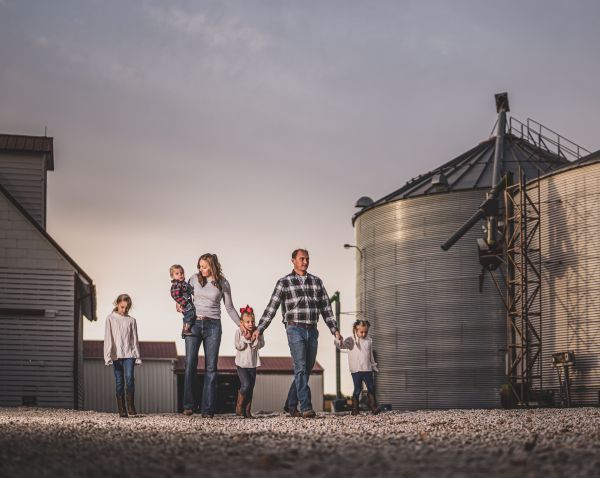
A family is walking in front of a grain silo holding hands.

The farmers that power Illinois' economy


Agriculture is a driving force behind Illinois’s economy, with 75 percent of Illinois’ land area being managed by Illinois farmers.
 

The United States Department of Agriculture’s Economic Research Service reports in 1900, forty-one percent of America’s workforce was employed in agriculture.


In 2021, 1.3 percent of the population worked directly on a farm. 


“I feel honored,” said Illinois corn farmer Marty Marr of New Berlin, IL. “I get to be a part of a small group of people making a huge impact.”

The state’s economic value begins in corn and soybean fields but reaches far beyond rural communities. One out of every ten dollars generated in Illinois originates from agriculture, impacting every person throughout the state.

The latest agricultural census reported more than $137 billion in Illinois’s economic activity is generated from production agriculture related industries. Additionally, Illinois food and agricultural businesses accounts for more than $356 billion in economic output for the state.

Cook County alone, derives $17.8 million in economic activity from agriculture and connected industries.


“Agricultural powerhouses like Illinois and other Midwestern states have much to offer our country's economy,” Jim Reed, a DeLand farmer said. “The jobs that support the food, fuel, fiber and capital this industry creates cannot go without notice. We are a much-needed economic force.” 


Illinois agriculture is impressive, ranking nationally as the largest producer of soybeans, the second largest producer of corn, and the fourth leading pork producer. Illinois is also home to the third most farmers markets in the United States.


With an industry this large, it is important policies and communications efforts support the best interests of the sector and the people of Illinois. Agribusiness and food marketing is one of six industries Illinois’s Department of Commerce highlights as a key industry it would like to see continue to grow. Illinois’s overall economy has the fifth highest Gross Domestic Product in the United States.


Agriculture also creates a high demand for employment. One in 17 jobs in Illinois are within agriculture and its associated industries, accounting for over 482,000 positions. Additionally, 1.7 million jobs are supported by Illinois agriculture.


Although the overall population has fewer ties to farming today than in our state’s history, families are still at the core of Illinois’s agricultural production.


A remarkable 96 percent of farmers in Illinois are family-owned.


“The importance of our industry is understated in Illinois and the United States,” said Chris Gould, a farmer in Elburn. “We help drive the economy and bring people together. We grow their food! But we do it quietly sometimes, and we make it too easy to forget about how important our job is.”

Baby with Corn Plastic Food Containers
By Pearl McDade June 12, 2026
Explore how corn is converted into PLA bioplastic for cups, food packaging, and 3D printing as demand grows for sustainable materials.
PCMthumbnail
By Tara Desmond June 11, 2026
PCM's 2026 Data Book, featured in this week's Prairie Farmer, shares 11 years of field data proving conservation and profitability go hand in hand.
By Tara Desmond June 11, 2026
How much do you know about the farmers who came before you and the decisions that still shape Illinois agriculture today? That's what University of Illinois student Lyndon Shi set out to explore during his internship with IL Corn . What began as an archival research project became a deeper look at the history of farmer leadership, innovation and advocacy in Illinois. While digging through university archives, Lyndon uncovered an undigitized manuscript from agricultural economist Harold Guither explaining the case for checkoffs. When he mentioned the discovery to IL Corn Director Rod Weinzierl, he got an unexpected response: "Oh yeah, I know him. We worked with him." It was a reminder that agricultural history isn't as distant as it may seem. Lyndon's research connected two eras of the IL Corn Growers Association: the original organization founded in the 1890s and the modern ICGA established in the 1970s. He learned how University of Illinois agriculture dean Eugene Davenport helped organize corn growers and sent professors across the state on "Corn Gospel Trains" to share the latest farming research. One story stood out in particular: the adoption of hybrid corn. Farmers who once judged corn by the appearance of the ear had to shift their focus to yield. Lyndon sees a similar transition today, as farmers increasingly balance yield with profitability amid rising input costs. "Illinois corn farmers are very good at organizing, and they are genuinely very grassroots," Lyndon said. "They've had a much more active role in shaping policy rather than just being on the receiving end." This Summer and Fall, Lyndon will travel to Taiwan on a federal scholarship to study food security. He'll do so with a new appreciation for Illinois agriculture's global connections, including Taiwan's longstanding role as an important trading partner. Watch the full conversation on IL Corn TV to hear Lyndon's research firsthand and discover how Illinois corn's history continues to influence the future.
Matt at USAPEEC Strategic Conference
By Tara Desmond June 11, 2026
IL Corn director Matt Raben was elected to USAPEEC's executive committee at the organization's 37th Annual Meeting this week.
Green world map with black curved arrows linking North America to Europe and Asia
By Lyndi Allen June 11, 2026
As one of the nation’s top agriculture exporters, Illinois ships corn to buyers across the globe—but where is it all going
Brian
By Tara Desmond June 11, 2026
Funk's Farm manager Brian Bangert explains the farm's 200-year history, the origins of Funk's G Hybrid, and how corn powers their cattle operation today.
Show More