Corn to Capitol: Bunting Serves Second Year as State Rep.

Haley Bickelhaupt
January 23, 2024
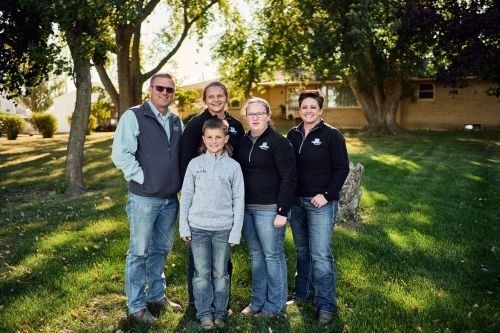
A family is posing for a picture in front of a house.

An unconventional pathway to Springfield did not falter Jason Bunting’s steadfast support for agriculture as a freshman member of Illinois’s General Assembly.

Former IL Corn Grower Association (ICGA) Director Jason Bunting helped pass two bills rooted in farming during his first year as the state representative for Illinois’s 106th district. This January, he introduced HB 4422, a bill allowing county governments to reinstate tougher regulations for wind and solar developments.


“I spent two decades coming down and sitting on the other side of the table advocating for agriculture issues and the rural lifestyle,” said Bunting. “I thought a person could just sit back and complain about what's happening in Springfield with the Capitol, or I can come down here and try and make a difference.”

Bunting was appointed to the General Assembly in early February 2022, following Senator Jason Barickman‘s resignation. Former Representative Thomas Bennett’s appointment to the Senate opened the seat Bunting filled in the House of Representatives.


A farmer and experienced public servant, Bunting’s route to office may have been atypical but his involvement in political affairs was not. Before his role as state representative, he served as the Highway Commissioner of Broughton Township, as a Livingston County Board member, and as the President of the Livingston County Farm Bureau.

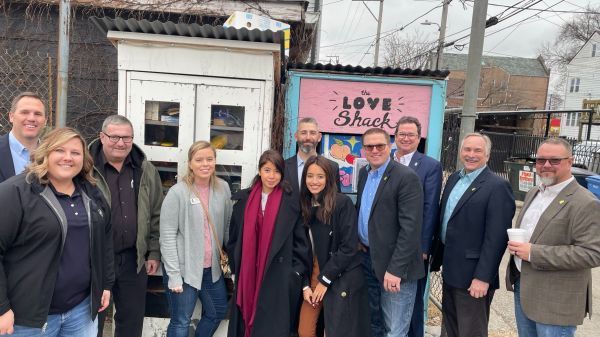
A group of people are posing for a picture in front of a love shack.

“I've always had aspirations to potentially come down to Springfield to represent the folks in my district, and I jumped at the chance,” Bunting said.


A strong voice for agriculture last year, Bunting sponsored HR0628, a resolution which named Farm Safety Week September 17-23, 2023. He joined forces with elected officials on both sides of the aisle to highlight the important role of Soil and Water Conservation Districts in a bill originally sponsored by Senator David Koehler.


“I jumped at the opportunity for the simple fact that I watched my mom and dad fight and advocate for soil water conservation districts for the last forty years,” Bunting said. “The legislation brings a public perception to the good work the Soil and Water Conservation Districts and our farmers do to preserve the soil and steward the land.”

Spring session for Illinois’ General Assembly began on January 16, 2024, and is scheduled to adjourn May 24, 2024. Bunting said ethics reform, a review of the estate tax, and the role of local government will be key in upcoming months.


“There's a number of things that we need to work on,” Bunting said. “We need to actually reach across the aisle and find some common ground, and I think we can do it.”


“The addition of Jason to Illinois’s General Assembly is a breath of fresh air for rural America,” said farmer and ICGA President Dave Rylander. “Our connection to multiple former board members and many allies in the state legislature allows us to continue making leaps of progress for our farmer members.” As a representative, Bunting values hearing concerns directly from his constituents. A practice he said is well exemplified in numerous grassroots organizations. Bunting said it is important for associations to be politically active to accomplish legislative goals.


“In agriculture, we need a seat at the table,” Bunting said. “You know, the common analogy, if we don't have a seat at the table, we're on the plate. So, it's extremely important that our voices are heard.”


The IL Corn Growers Association gives you a seat at the table. Not a member, join today!

Lou Lamoreux Farm
By Tara Desmond September 3, 2026
Livestock farmer Lou Lamoreux talks about his farming operation.
captain Cornelius at shake it up cocktail lounge
By Tara Desmond September 3, 2026
4.29M bushels of U.S. corn fueled beverage alcohol production in July 2026 alone — up 54% from July 2025. Corn's in your Labor Day toast!
aerial view of short corn
By Tara Desmond September 3, 2026
Illinois farmer Steve Fourez tests short stature corn against conventional hybrids, exploring yield potential and late-season management benefits.
USDA building
By Lyndi Allen September 3, 2026
This week, U.S. Secretary of Agriculture Brooke L. Rollins announced the U.S. Department of Agriculture (USDA) Data Modernization Plan to put Farmers First, reduce unnecessary burdens on producers, and improve the timeliness, accuracy, and usefulness of the data that informs agricultural decisions. USDA data informs crop and livestock estimates, risk-management tools, disaster assistance, and critical business decisions made by farmers, ranchers, agribusinesses, researchers, and policymakers. In February 2026, Secretary Rollins issued a Request for Information seeking feedback on the opportunities, challenges, and emerging areas in USDA data. That feedback helped shape the USDA Data Modernization Plan and its four pillars: Modernize the Data Reporting Experience: USDA will expand use of administrative data, improve mobile access to surveys, explore opportunities to use prefilled information where appropriate, and strengthen coordination across the Department. These changes will reduce duplicative requests and limit the amount of time producers spend reporting information. Enhance Acreage and Yield Estimation: USDA will conduct a pilot to evaluate the use of improved satellite imagery, geospatial tools, crop models, and other emerging technologies combined with essential producer-reported information to enhance acreage and yield estimations. USDA will also assess the use of optional field inputs to enhance and ground truth yield estimates and continue advancing yield research through collaboration with agricultural partners and land-grant universities. Integrate Data and Technology Platforms: USDA will modernize its technology infrastructure, expand secure data-sharing capabilities, and evaluate the responsible use of tools such as artificial intelligence and machine learning. Better integrated systems will improve efficiency, reduce duplication, and allow USDA to produce more timely and useful information. Expand Trust and Transparency with Producers: USDA will protect producer privacy, clearly explain why information is requested and how it is used, and create additional opportunities for producers to provide feedback. USDA will also improve communication surrounding reports, methodologies, response rates, and data limitations. USDA will begin implementing actions under the plan immediately and will continue engaging farmers, ranchers, and agricultural stakeholders throughout the process. The Department will evaluate new approaches carefully, protect privacy and confidentiality, and publish clear methodologies and supporting information to maintain the integrity of USDA’s agricultural statistics. See USDA’s Full Data Modernization Plan
Cornfield beside a dirt path under a blue sky with wispy clouds
By Lyndi Allen September 2, 2026
EPA has granted 1.76 billion RIN exemptions to small refiners, raising concerns among farmers and biofuel producers about the potential impact on demand for renewable fuel.
Weekly News
By Lyndi Allen August 28, 2026
News from IL Corn for week ending 8/28/26
Show More