From Fields to Flight: IL Corn Plays Role in SAF Conference

March 28, 2024
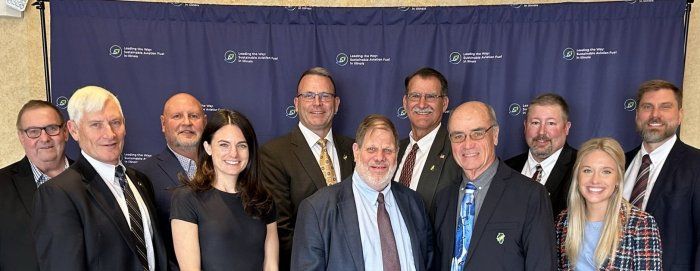
A group of people in suits and ties are posing for a picture.

Seeds are being sown to position Illinois as a hub for sustainable aviation fuel (SAF). On March 21-22, IL Corn and the Illinois Manufacturing Association hosted the inaugural Sustainable Aviation Fuel Conference in Lisle, Illinois. The event united stakeholders in the airline, policy, petroleum, transportation, ethanol, and agricultural sectors. 

“We believe our state has a unique opportunity to combine our agriculture industry, geology, and airline presence around the common goal of decarbonizing the aviation sector,” Pilot and Illinois Corn Growers Association (ICGA) director Chris Gould said. “Corn-based ethanol is an excellent feedstock for SAF. I look forward to being part of this emerging market both as a farmer, doing the right thing, and as a pilot, being fueled by the right thing. 


Federal policy and early state legislation gives Illinois an advantage for SAF production. 


In 2022, the Inflation Reduction Act (IRA) created a $1.25 SAF producer tax credit for fuel with at least a 50% greenhouse gas reduction. In 2023, Illinois enacted the first $1.50 state purchaser SAF tax credit. 

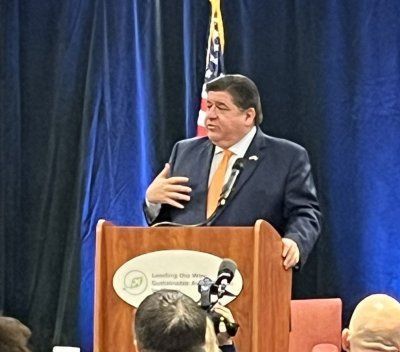
A man in a suit and tie is giving a speech at a podium

“From production and refining to retail, everything you need is here. We are the nation's number one producer of soybeans, number two producer of corn. We’re responsible for 90 percent of the US oilseed production," Illinois Governor JB Pritzker said in his keynote speech at the conference. 


A longtime champion of renewable fuels, Senator Tammy Duckworth (IL-D) highlighted her work ensuring the Department of Energy’s Argonne GREET model can be used to qualify for the SAF tax credits. 


The GREET model accurately portrays the lifecycle analysis of corn-based ethanol’s carbon emissions and is recognized worldwide as the best scientific model for GHG emissions of transportation fuels. Under the GREET model corn-based ethanol qualifies for IRA credits. On March 1, U.S. Department of Agriculture Secertary Tom Vilsack announced a delay in the release of a revised GREET model to be used for SAF production leaving farmers and SAF producers in limbo on their ability to participate in the market. 


Referencing the Biden Administration’s 3-billion-gallon SAF goal by 2030, National Corn Growers Association Chief Economist Krista Swanson said agriculture can meet the need if allowed to participate. “The potential there is great if we have the modeling in place that allows for ‘ethanol-to-jet’ to happen,” she said. 


Swanson said productivity increases would allow corn farmers to produce an extra billion bushel of corn in 2030 on the same number of acres. “We have the ability to meet that demand and also the opportunity to expand ethanol use into a whole new realm,” she said. 


“The conference planted seeds and started conversations critical to future developments of SAF,” Swanson said. “As corn farmers we just need federal support for the opportunity to make sure we have a seat at the table.” 

Baby with Corn Plastic Food Containers
By Pearl McDade June 12, 2026
Explore how corn is converted into PLA bioplastic for cups, food packaging, and 3D printing as demand grows for sustainable materials.
PCMthumbnail
By Tara Desmond June 11, 2026
PCM's 2026 Data Book, featured in this week's Prairie Farmer, shares 11 years of field data proving conservation and profitability go hand in hand.
By Tara Desmond June 11, 2026
How much do you know about the farmers who came before you and the decisions that still shape Illinois agriculture today? That's what University of Illinois student Lyndon Shi set out to explore during his internship with IL Corn . What began as an archival research project became a deeper look at the history of farmer leadership, innovation and advocacy in Illinois. While digging through university archives, Lyndon uncovered an undigitized manuscript from agricultural economist Harold Guither explaining the case for checkoffs. When he mentioned the discovery to IL Corn Director Rod Weinzierl, he got an unexpected response: "Oh yeah, I know him. We worked with him." It was a reminder that agricultural history isn't as distant as it may seem. Lyndon's research connected two eras of the IL Corn Growers Association: the original organization founded in the 1890s and the modern ICGA established in the 1970s. He learned how University of Illinois agriculture dean Eugene Davenport helped organize corn growers and sent professors across the state on "Corn Gospel Trains" to share the latest farming research. One story stood out in particular: the adoption of hybrid corn. Farmers who once judged corn by the appearance of the ear had to shift their focus to yield. Lyndon sees a similar transition today, as farmers increasingly balance yield with profitability amid rising input costs. "Illinois corn farmers are very good at organizing, and they are genuinely very grassroots," Lyndon said. "They've had a much more active role in shaping policy rather than just being on the receiving end." This Summer and Fall, Lyndon will travel to Taiwan on a federal scholarship to study food security. He'll do so with a new appreciation for Illinois agriculture's global connections, including Taiwan's longstanding role as an important trading partner. Watch the full conversation on IL Corn TV to hear Lyndon's research firsthand and discover how Illinois corn's history continues to influence the future.
Matt at USAPEEC Strategic Conference
By Tara Desmond June 11, 2026
IL Corn director Matt Raben was elected to USAPEEC's executive committee at the organization's 37th Annual Meeting this week.
Green world map with black curved arrows linking North America to Europe and Asia
By Lyndi Allen June 11, 2026
As one of the nation’s top agriculture exporters, Illinois ships corn to buyers across the globe—but where is it all going
Brian
By Tara Desmond June 11, 2026
Funk's Farm manager Brian Bangert explains the farm's 200-year history, the origins of Funk's G Hybrid, and how corn powers their cattle operation today.
Show More