
Illinois Corn Farmers Approve Increased Checkoff Investment

April 21, 2022
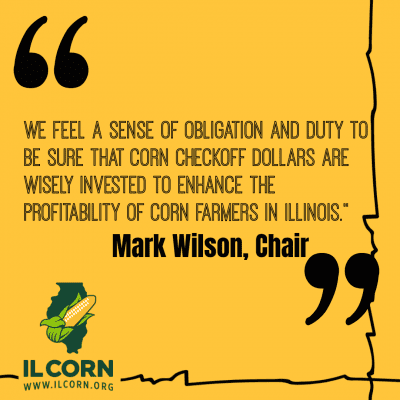
A quote from mark wilson is on a yellow background

Illinois corn farmers voted in favor of increasing the corn checkoff rate established in the Illinois Corn Marketing Act in a vote held March 29, 2022, according to Illinois Department of Agriculture.


View the official notice from the Illinois Department of Agriculture here.


The referendum, which passed in an 88%-12% vote of all farmers subject to the act, will result in the current 5/8 cent corn checkoff rate increasing to 7/8 of a cent-per-bushel. The program will retain the right to refund and the new rate will take effect October 1, 2022.


“We understand that it is important that we continue to invest these checkoff dollars with integrity to achieve the goals and meet the needs of corn farmers in Illinois,” said Mark Wilson, ICMB Chairman.

ICMB is governed by a volunteer board of corn farmers elected by their peers. These farmers invest the checkoff funds. The increase in funds will be used to:


  1. Educate the public and government officials on the need for improved waterways infrastructure to compete in a global marketplace. 
  • We have successfully secured funding for modernization of Lock #25 on the Mississippi River. There are six additional locks on the Mississippi and Illinois Rivers that must be modernized to achieve long term competitive benefits for Illinois farmers.
  1. Position corn farmers to increase relevance among non-farmers and prevent regulations on agriculture by engaging with the public and officials. 
  2. Grow the domestic fuel ethanol market and combat the influence of electric vehicles, and research alternative markets for ethanol, like sustainable aviation fuel, and other new uses, such as corn-based plastics.
  3. Build diverse export opportunities in established and emerging markets for corn, ethanol, DDGS, red meat, and poultry.


“These focus areas were determined after much thought and analysis,” adds Wilson. “We surveyed corn farmers and considered the input provided by the members of the IL Corn Growers Association. We feel a sense of obligation and duty to be sure that corn checkoff dollars are wisely invested to enhance the profitability of corn farmers in Illinois.”


“It’s encouraging to see that the farmers in Illinois have shown they see the value of the check off and the hard work of IL Corn committing to a stronger voice for ag for the future,” comments Martin Marr, Illinois Corn Growers Association President.


The Illinois Corn Marketing Act was established by farmers in 1982 as a means to fund corn market development, research, promotion and education efforts. The last rate increase went into effect on October 1, 2012.


Don't want to read the story? Listen to Mark Wilson talk about the future investments here:

Lou Lamoreux Farm
By Tara Desmond September 3, 2026
Livestock farmer Lou Lamoreux talks about his farming operation.
captain Cornelius at shake it up cocktail lounge
By Tara Desmond September 3, 2026
4.29M bushels of U.S. corn fueled beverage alcohol production in July 2026 alone — up 54% from July 2025. Corn's in your Labor Day toast!
aerial view of short corn
By Tara Desmond September 3, 2026
Illinois farmer Steve Fourez tests short stature corn against conventional hybrids, exploring yield potential and late-season management benefits.
USDA building
By Lyndi Allen September 3, 2026
This week, U.S. Secretary of Agriculture Brooke L. Rollins announced the U.S. Department of Agriculture (USDA) Data Modernization Plan to put Farmers First, reduce unnecessary burdens on producers, and improve the timeliness, accuracy, and usefulness of the data that informs agricultural decisions. USDA data informs crop and livestock estimates, risk-management tools, disaster assistance, and critical business decisions made by farmers, ranchers, agribusinesses, researchers, and policymakers. In February 2026, Secretary Rollins issued a Request for Information seeking feedback on the opportunities, challenges, and emerging areas in USDA data. That feedback helped shape the USDA Data Modernization Plan and its four pillars: Modernize the Data Reporting Experience: USDA will expand use of administrative data, improve mobile access to surveys, explore opportunities to use prefilled information where appropriate, and strengthen coordination across the Department. These changes will reduce duplicative requests and limit the amount of time producers spend reporting information. Enhance Acreage and Yield Estimation: USDA will conduct a pilot to evaluate the use of improved satellite imagery, geospatial tools, crop models, and other emerging technologies combined with essential producer-reported information to enhance acreage and yield estimations. USDA will also assess the use of optional field inputs to enhance and ground truth yield estimates and continue advancing yield research through collaboration with agricultural partners and land-grant universities. Integrate Data and Technology Platforms: USDA will modernize its technology infrastructure, expand secure data-sharing capabilities, and evaluate the responsible use of tools such as artificial intelligence and machine learning. Better integrated systems will improve efficiency, reduce duplication, and allow USDA to produce more timely and useful information. Expand Trust and Transparency with Producers: USDA will protect producer privacy, clearly explain why information is requested and how it is used, and create additional opportunities for producers to provide feedback. USDA will also improve communication surrounding reports, methodologies, response rates, and data limitations. USDA will begin implementing actions under the plan immediately and will continue engaging farmers, ranchers, and agricultural stakeholders throughout the process. The Department will evaluate new approaches carefully, protect privacy and confidentiality, and publish clear methodologies and supporting information to maintain the integrity of USDA’s agricultural statistics. See USDA’s Full Data Modernization Plan
Cornfield beside a dirt path under a blue sky with wispy clouds
By Lyndi Allen September 2, 2026
EPA has granted 1.76 billion RIN exemptions to small refiners, raising concerns among farmers and biofuel producers about the potential impact on demand for renewable fuel.
Weekly News
By Lyndi Allen August 28, 2026
News from IL Corn for week ending 8/28/26
Show More