Base Acre Update 101

Lyndi Allen
December 18, 2025

Decades-Old Base Acres, Uneven Payments, and Impact on Illinois Corn Farmers

Imagine receiving a government payment for a crop you no longer grow, while planting a different crop with stronger market prices. That scenario isn’t hypothetical. It is how the U.S. Department of Agriculture (USDA) commodity programs operate today—using base acres tied to historical production rather than current planting decisions. This system was implemented to ensure that payments would not be perceived as influencing what farmers plant, helping keep U.S. farm programs compliant with World Trade Organization (WTO) rules. While that structure made sense at the time, it now drives uneven payment outcomes and raises questions about fairness and accuracy. 


What are Base Acres and How are they Used?

Base Acres are most commonly used to determine payments such as Agriculture Risk Coverage (ARC) and Price Loss Coverage (PLC), which rely on existing base acres from the USDA database. These acres report the designated acreage used to calculate commodity program payments and are not tied to what is planted in a given year. The last mandatory base acre update was in 1985, which shifted payments from planting decisions to historical base acres.


The 2002 and 2014 Farm Bills offered limited, voluntary base reallocation options. These updates did not require farms to align base acres with current planting patterns. The 2014 Farm Bill specifically allowed a one-time reallocation of base acres, but this was optional and did not automatically change base acres for all farms.

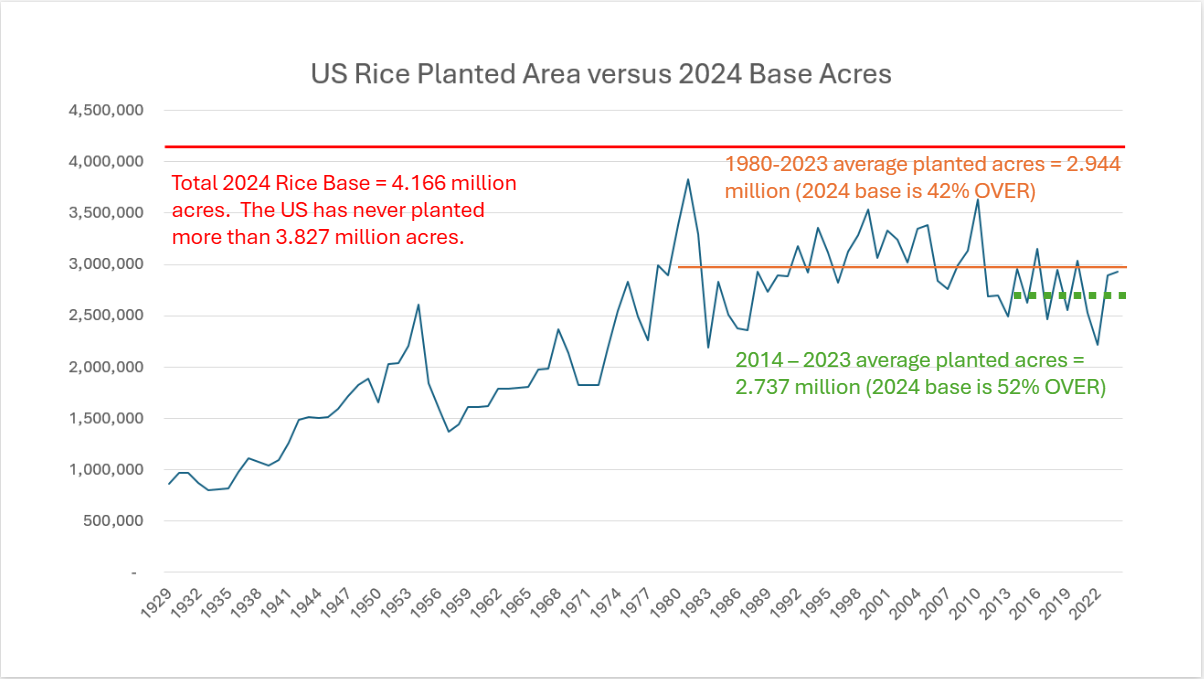
Line graph: US rice planted area versus 2024 base acres. Trends shown with overlaid text and data points.
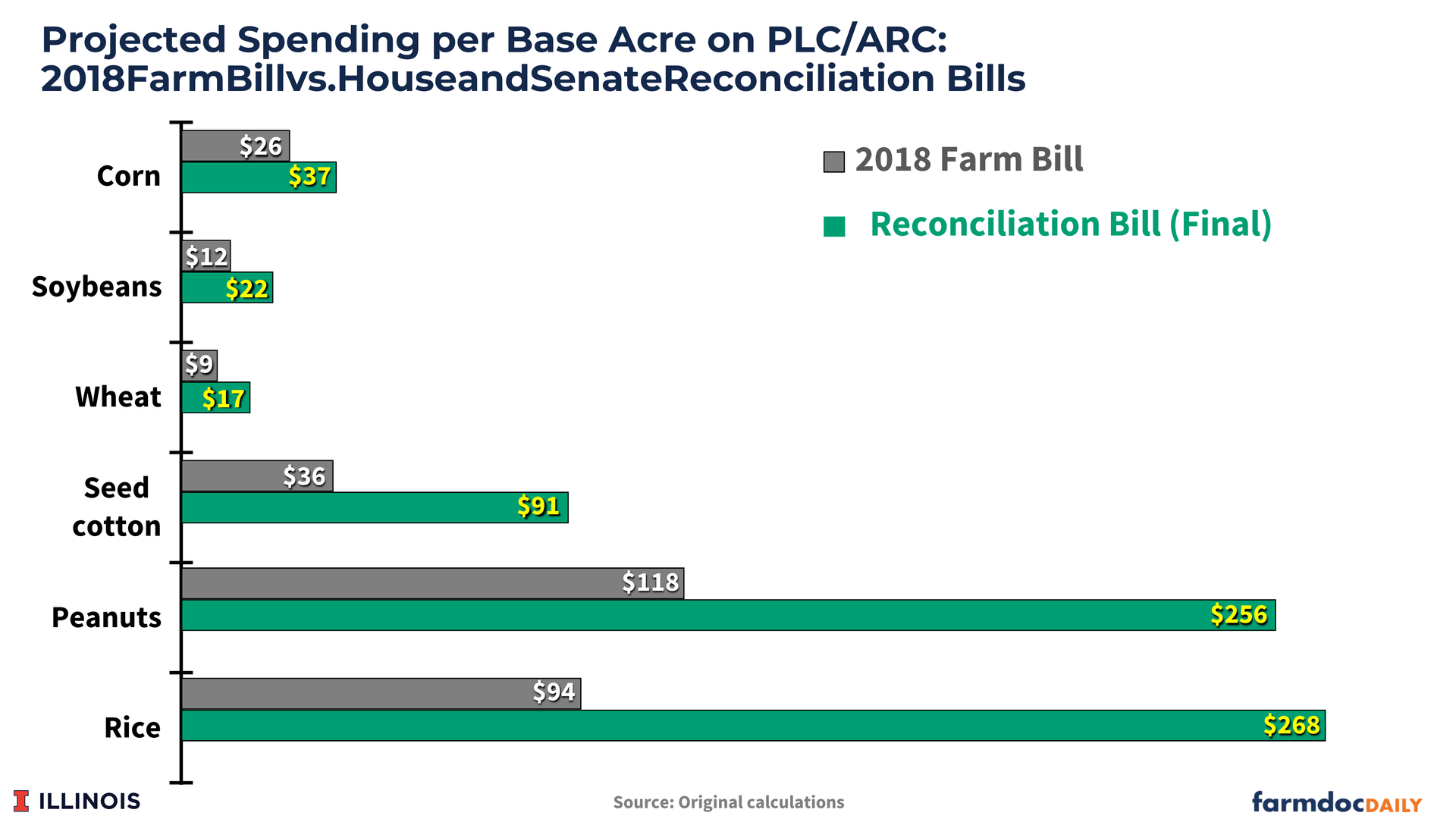
Comparison of projected spending per acre on PLC/ARC for 2018 Farm Bill vs. Reconciliation Bill (Final), showing data for various crops.

Why this Matters

Since farmers have not been required to update base acres since 1985, many farms continue to receive commodity program support based on planting patterns from decades past, even when actual planting decisions have drastically changed. This reliance on a historical base is why proposals such as the Balanced Agricultural Support and Efficiency (BASE) Act, introduced by Rep. Dusty Johnson and co-sponsored by Rep. Nikki Budzinski, seek to introduce a mandatory update requirement for the first time in over 40 years, changing how commodity support is distributed.


Illinois farmers largely plant corn on acres that are already reflected as corn base, meaning payments are generally more aligned with their rates. Meanwhile, farmers who shifted production away from cotton years ago may still benefit from their historical base that no longer matches what is being grown today—but continue to receive payments tied to historical cotton base acres.


Without a mandatory base acre update, historical base acres that do not reflect current planting practices will continue to influence who benefits most from USDA commodity support, even when farms across the country are producing the same crops.


IL Corn will continue to meet with legislators about this issue to improve the program's integrity. The analysis funded by the Illinois corn checkoff and the advocacy from the IL Corn Growers Association seeks to protect the future of farm safety nets and provide more accurate support for farmers today. 

barge
By Tara Desmond December 17, 2025
New export data from USDA and the U.S. Grains Council shows continued global demand for U.S. grains.
Matt Raben
By Tara Desmond December 17, 2025
Illinois corn farmers share conservation and ethanol practices in Japan, strengthening trust and long-term trade with a key U.S. corn market.
Shane Gray and Robbie Morris
By Tara Desmond December 17, 2025
Bluegrass meets agriculture as Grass Time Band’s Robbie Morris shares his farm roots, music, and new song “Cotton, Corn and Hay” on Illinois Corn TV.
field corn
By National Corn Growers Association & Tara Desmond December 17, 2025
Illinois farmers earned top honors in the 2025 NCGA Yield Contest.
collage
By Tara Desmond December 11, 2025
Interview with former NCGA President Kenny Hartman, Jr., reflecting on decades of service to Illinois corn farmers, major policy accomplishments, and why young farmers should get involved to shape the future of agriculture.
IL Corn office
By U.S. Grains & Bioproducts Council & IL Corn December 11, 2025
Illinois corn was on full display as a delegation of Japanese journalists toured the U.S. biofuels value chain to better understand how American corn and corn ethanol contribute to a lower-carbon energy future.
Show More