
Illinois FFA Chapters Water Testing Challenge Winners Announced

January 18, 2024
A woman in a pink t-shirt and blue jeans is sitting in front of a building.

1st Place – Lainie Clark - Fairfield FFA


"Thank you so much to the IL Corn and Illinois Soybean Association for this opportunity. I would also like to thank my advisors, Mr. Curt Robbins and Mrs. Samantha Smith for their assistance throughout the project. I feel that it is important to continue to learn safer farming practices to ensure a better environment for years to come. I will use this money to further my education at Eastern Illinois University."

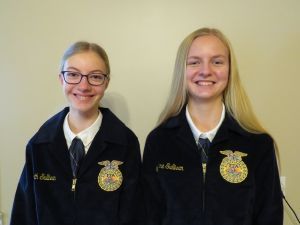
2nd Place – Anna and Ruth Sullivan- Home Fires FFA


Anna and Ruth Sullivan said, “We are glad to know more about nitrogen and to help support our chapter with this project."

Homeschool Teacher Shaun Sullivan said, "It was great to have a homeschool project where the girls and our whole family could gain knowledge and a greater understanding of the role of nitrogen in agriculture and the implications of the practices used by farmers regarding nitrogen around where we live, including on our own farm. They were then able to better comprehend the potential impact it may have on water quality."  

Two girls are posing for a picture and one of them is wearing glasses

3rd Place – Gavin Friel- Blue Ridge FFA

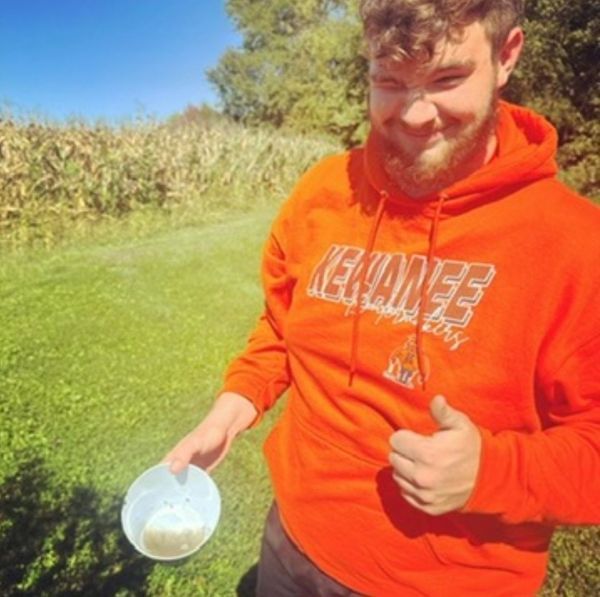
4th Place – Daniel Boswell, Isaac Lynes and Jazmen Moran - Kewanee FFA


Isaac Lynes says, "My experience doing the water hypothesis was an interesting and informative experience. Through this learning process I learned the importance of knowing your surroundings ,and especially your safety when it comes to water. This is important for many reasons. Bodily health and environmental safety. Ingesting unsafe water is super unsafe. So overall I've learned the value of water safety and how and where people collect water. I'm super grateful for this experiment I've learned a lot."

A man wearing an orange hoodie that says kentucky giving a thumbs up

For the 2nd year IL Corn partnered with Illinois Soybean Association to offer the Water Testing Challenge to all Illinois FFA chapters. This hands on educational program challenged students to sample water from different areas on the farms, then analyze that data with a report that included improvement suggestions and management changes with explanations on why it should change.


"We were thrilled by the engagement and the chance to educate the future generation of agriculturalists the importance of the IL Nutrient Loss Reduction Strategy and general best management practices. Acquiring the skills to recognize potential challenges and devise solutions is a valuable asset for their future. The vitality of soil health and environmental stewardship is pivotal to the future of agriculture," said Megan Dwyer, Director of Conservation and Nutrient Stewardship at IL Corn.

Get to know the Winners


5th Place – Dominic Hagan, Brett Hilmes, Wyatt Paterson, Christian Schwarz, Chase Voss, Angeleen Wesselmann, and Bradley Huelsmann - Mater Dei Catholic FFA


Teacher Erika Knolhoff states, “I enjoy getting the students involved in this. I really get to see some of them get engaged and really think about where they would like to take samples. When the samples come up with low levels of Nitrogen they think something is wrong but we go back to the fact that that is probably a good thing. It gives real life context as to why the detailed science learning is important so we can understand what is happening in our real world. A great way to get students to see the significance of nutrient management. This year I had several students that are just as interested in Natural Resources topics and I was able to bridge this to overall water quality for our local and regional ecosystems.”

Lou Lamoreux Farm
By Tara Desmond September 3, 2026
Livestock farmer Lou Lamoreux talks about his farming operation.
captain Cornelius at shake it up cocktail lounge
By Tara Desmond September 3, 2026
4.29M bushels of U.S. corn fueled beverage alcohol production in July 2026 alone — up 54% from July 2025. Corn's in your Labor Day toast!
aerial view of short corn
By Tara Desmond September 3, 2026
Illinois farmer Steve Fourez tests short stature corn against conventional hybrids, exploring yield potential and late-season management benefits.
USDA building
By Lyndi Allen September 3, 2026
This week, U.S. Secretary of Agriculture Brooke L. Rollins announced the U.S. Department of Agriculture (USDA) Data Modernization Plan to put Farmers First, reduce unnecessary burdens on producers, and improve the timeliness, accuracy, and usefulness of the data that informs agricultural decisions. USDA data informs crop and livestock estimates, risk-management tools, disaster assistance, and critical business decisions made by farmers, ranchers, agribusinesses, researchers, and policymakers. In February 2026, Secretary Rollins issued a Request for Information seeking feedback on the opportunities, challenges, and emerging areas in USDA data. That feedback helped shape the USDA Data Modernization Plan and its four pillars: Modernize the Data Reporting Experience: USDA will expand use of administrative data, improve mobile access to surveys, explore opportunities to use prefilled information where appropriate, and strengthen coordination across the Department. These changes will reduce duplicative requests and limit the amount of time producers spend reporting information. Enhance Acreage and Yield Estimation: USDA will conduct a pilot to evaluate the use of improved satellite imagery, geospatial tools, crop models, and other emerging technologies combined with essential producer-reported information to enhance acreage and yield estimations. USDA will also assess the use of optional field inputs to enhance and ground truth yield estimates and continue advancing yield research through collaboration with agricultural partners and land-grant universities. Integrate Data and Technology Platforms: USDA will modernize its technology infrastructure, expand secure data-sharing capabilities, and evaluate the responsible use of tools such as artificial intelligence and machine learning. Better integrated systems will improve efficiency, reduce duplication, and allow USDA to produce more timely and useful information. Expand Trust and Transparency with Producers: USDA will protect producer privacy, clearly explain why information is requested and how it is used, and create additional opportunities for producers to provide feedback. USDA will also improve communication surrounding reports, methodologies, response rates, and data limitations. USDA will begin implementing actions under the plan immediately and will continue engaging farmers, ranchers, and agricultural stakeholders throughout the process. The Department will evaluate new approaches carefully, protect privacy and confidentiality, and publish clear methodologies and supporting information to maintain the integrity of USDA’s agricultural statistics. See USDA’s Full Data Modernization Plan
Cornfield beside a dirt path under a blue sky with wispy clouds
By Lyndi Allen September 2, 2026
EPA has granted 1.76 billion RIN exemptions to small refiners, raising concerns among farmers and biofuel producers about the potential impact on demand for renewable fuel.
Weekly News
By Lyndi Allen August 28, 2026
News from IL Corn for week ending 8/28/26
Show More