Illinois Pork, IL Corn and ISA Donate Pork to IL Foodbanks

January 12, 2021
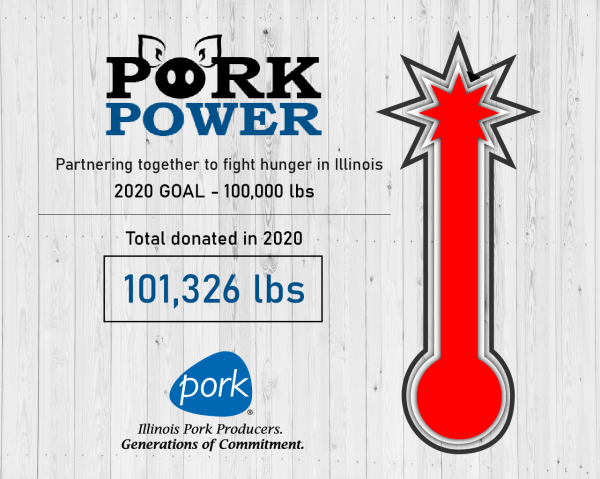
A poster for pork power with a red thermometer

Since its inception, Pork Power: Partnering to Fight Hunger in Illinois campaign has donated over 3 million servings of pork to date. In 2020 alone, the program donated 101,326 pounds of pork throughout the state.

Farmers and partnering commodity groups work together to donate to the program year-round in order to help feed those in need. Lead by the Illinois Pork Producers Association (IPPA), IL Corn and the Illinois Soybean Association (ISA) join in for the program to get much needed protein to hungry people.

“The Pork Power project is one of my favorite projects IL Corn invests in,” commented Dirk Rice, ICMB Chairman. “As a farmer, I feel very connected to the job of feeding hungry people and this project allows all farmers, all over Illinois, to do just that. I’ve seen how happy the food banks and their customers are to receive the excellent protein source we are donating. This is a great opportunity to give back to our communities, work together for good, and eat more pork.”

Towards the end of each calendar year IPPA turns the remaining funds into ground pork and divides it among the regional food banks in the state. As part of the end-of-the-year giving campaign, over 47,900 pounds were delivered to the Illinois regional food banks in the months of November and December alone, just in time for the holidays. This year is especially important due to high unemployment figures.

The donations are spread to every corner of the state. Those who received pork include, Central Illinois Foodbank in Springfield, Eastern Illinois Foodbank in Urbana, Greater Chicago Food Depository, Midwest Foodbank in Normal, Northern Illinois Foodbank in Rockford, Peoria Area Foodbank, River Bend Foodbank in Davenport, IA, St. Louis Area Foodbank and the Tri-State Foodbank in Evansville, IN. From these larger foodbanks, donations are dispersed to community food pantries in the city, suburbs and small towns.

A special thank you goes towards the following processors who contributed time towards the ground pork donations and include, Chenoa Locker, Eichman's Processing Co., Main Street Meat, Schubert's Smokehouse, Slagel Family Meats, Steidinger Foods, Turkasy Meats and Y-T Packing Co.

IL Corn recognizes the importance of giving back, especially to those in our own community, and looks forward to being able to help every year.

“Now more than ever, we see the need to support our communities by supplying those in need with high quality protein,” states IPPA board president Dale Weitekamp. “The protein supply is available, and we wanted it to get it in the right hands just in time for the holidays.”

Related Stories

Dr. Yan Zhang, Justin Moore, Rod Weinzierl, Rep. Nikki Budzinski, Dr. Christopher Slaten, and Dr. Pr
By Lyndi Allen May 26, 2026
Congresswoman Nikki Budzinski is requesting federal funding for the National Corn-to-Ethanol Research Center through her Community Project Funding requests.
Shane and Taylor
By Tara Desmond May 21, 2026
Solinftec's Solix robot uses AI to target weeds in real time, cutting chemical use up to 90%. Solar-powered, autonomous, and built for Midwest farms.
Photo taken in McLean County Museum of History
By Tara Desmond May 21, 2026
Illinois Ag Across Time - Episode 2: Tracing 200 years of Illinois farm families, innovation, and the land that fed a nation.
Don Meyer
By Tara Desmond May 21, 2026
Illinois Ag Across Time — Tracing 200 years of Illinois farm families, innovation, and the land that fed a nation.
Hammer striking corn kernels on a wooden surface, with kernels scattering in a rustic barn setting
By Lyndi Allen May 21, 2026
Ethanol is a powerhouse for American farms, fuels American vehicles, and has strengthened America’s economy for decades, but remains one of the most misunderstood fuels on the road today.
Cargo containers lined up at a port beside a canal, under a bright sky
By Lyndi Allen May 21, 2026
For decades, America’s inland waterways operated on a system that couldn’t keep up—aging infrastructure, delayed projects, and a funding model that forced farmers and shippers to wait.
Show More