In Support of a New Lock and Dam Start in 2021

October 22, 2020
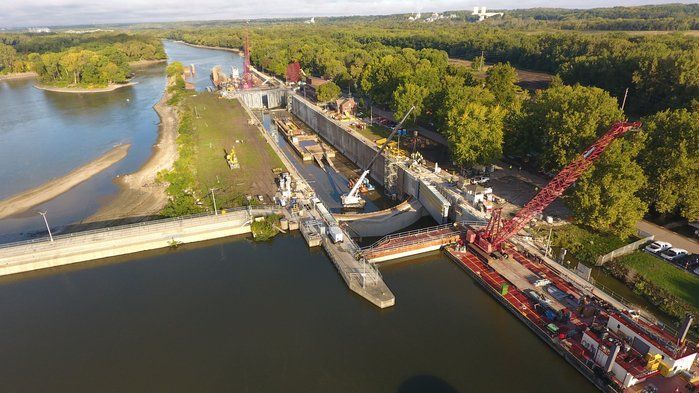
An aerial view of a bridge being built over a river.

This week, the Illinois Corn Growers Association has reached out to each member of the Illinois Congressional delegation, asking for their support in encouraging the Army Corps of Engineers to include a new start for a construction project in their Work Plan for Fiscal Year (FY) 2021 Civil Works.


The effort was initiated by Congresswoman Cheri Bustos, whose district stretches for miles along the Mississippi River.


The encouragement to the Army Corps of Engineers includes an ask to build from a $4.5 million for preconstruction engineering and design (PED) of the Upper Mississippi River and Illinois Waterway System projects in the FY20 Work Plan and allow that momentum to continue.

Lock and dam projects are included and prioritized in the Navigation and Ecosystem Sustainability Program (NESP), which was authorized in 2007 and allows the Corps to address by navigation and ecosystem restoration in an integrated approach. NESP would construct new locks at seven existing sites and provides comprehensive ecosystem restoration for the Upper Mississippi and Illinois Rivers.


NEPS maintains broad, bipartisan support in Congress.


Inland waterways infrastructure remains a critical priority of the Illinois Corn Growers Association because the Illinois and Mississippi Rivers provide a significant advantage for Illinois corn farmers that sell their corn out of our state. Approximately 40 percent of Illinois corn leaves the state for export.


Members of the Illinois delegation that have agreed to support a new lock and dam construction in the Upper Mississippi or Illinois River are:


Senator Tammy DuckworthRepresentative Mike Bost

Representative Cheri BustosSenator Richard DurbinRepresentative Sean Casten Representative Danny Davis Representative Rodney Davis Representative Bill Foster Representative Robin Kelly Representative Adam Kinzinger Representative Raja Krishnamoorthi Representative Darin LaHood Representative Daniel Lipinski Representative Mike Quigley Representative Bobby Rush Representative Jan Schakowsky Representative Bradley Schneider Representative John Shimkus Representative Lauren Underwood 


Watch for future updates to this story which will include members of the Illinois delegation that lend their support to this encouragement for a new lock and dam construction project in FY21.

Lou Lamoreux Farm
By Tara Desmond September 3, 2026
Livestock farmer Lou Lamoreux talks about his farming operation.
captain Cornelius at shake it up cocktail lounge
By Tara Desmond September 3, 2026
4.29M bushels of U.S. corn fueled beverage alcohol production in July 2026 alone — up 54% from July 2025. Corn's in your Labor Day toast!
aerial view of short corn
By Tara Desmond September 3, 2026
Illinois farmer Steve Fourez tests short stature corn against conventional hybrids, exploring yield potential and late-season management benefits.
USDA building
By Lyndi Allen September 3, 2026
This week, U.S. Secretary of Agriculture Brooke L. Rollins announced the U.S. Department of Agriculture (USDA) Data Modernization Plan to put Farmers First, reduce unnecessary burdens on producers, and improve the timeliness, accuracy, and usefulness of the data that informs agricultural decisions. USDA data informs crop and livestock estimates, risk-management tools, disaster assistance, and critical business decisions made by farmers, ranchers, agribusinesses, researchers, and policymakers. In February 2026, Secretary Rollins issued a Request for Information seeking feedback on the opportunities, challenges, and emerging areas in USDA data. That feedback helped shape the USDA Data Modernization Plan and its four pillars: Modernize the Data Reporting Experience: USDA will expand use of administrative data, improve mobile access to surveys, explore opportunities to use prefilled information where appropriate, and strengthen coordination across the Department. These changes will reduce duplicative requests and limit the amount of time producers spend reporting information. Enhance Acreage and Yield Estimation: USDA will conduct a pilot to evaluate the use of improved satellite imagery, geospatial tools, crop models, and other emerging technologies combined with essential producer-reported information to enhance acreage and yield estimations. USDA will also assess the use of optional field inputs to enhance and ground truth yield estimates and continue advancing yield research through collaboration with agricultural partners and land-grant universities. Integrate Data and Technology Platforms: USDA will modernize its technology infrastructure, expand secure data-sharing capabilities, and evaluate the responsible use of tools such as artificial intelligence and machine learning. Better integrated systems will improve efficiency, reduce duplication, and allow USDA to produce more timely and useful information. Expand Trust and Transparency with Producers: USDA will protect producer privacy, clearly explain why information is requested and how it is used, and create additional opportunities for producers to provide feedback. USDA will also improve communication surrounding reports, methodologies, response rates, and data limitations. USDA will begin implementing actions under the plan immediately and will continue engaging farmers, ranchers, and agricultural stakeholders throughout the process. The Department will evaluate new approaches carefully, protect privacy and confidentiality, and publish clear methodologies and supporting information to maintain the integrity of USDA’s agricultural statistics. See USDA’s Full Data Modernization Plan
Cornfield beside a dirt path under a blue sky with wispy clouds
By Lyndi Allen September 2, 2026
EPA has granted 1.76 billion RIN exemptions to small refiners, raising concerns among farmers and biofuel producers about the potential impact on demand for renewable fuel.
Weekly News
By Lyndi Allen August 28, 2026
News from IL Corn for week ending 8/28/26
Show More