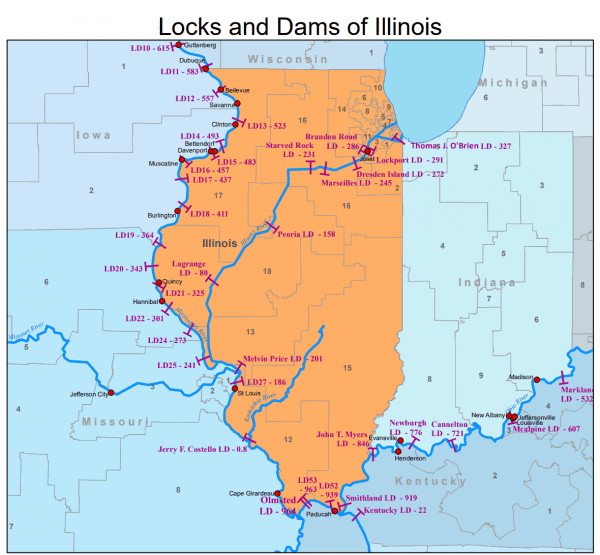
Illinois’ ports, inland waterways and inland waterways-dependent industries support more than 236,000 jobs, with 83 million tons of commodities valued at $13.2 billion moving on Illinois’ inland waterways. This cargo is transported by towboats pushing football field-sized barges laden with 21st century “building block” commodities like corn, soybeans, landscape and construction materials, road salt for icy roads, jet fuel for airports, chemicals and much more. That tonnage is equivalent to 2.1 million trucks on our roadways.
But while those cargoes support our modern economy today, most of the locks and dams on the inland waterways system that allow for boats to travel across varying depths without getting grounded or stuck were constructed during President Franklin D. Roosevelt’s New Deal of the 1930s, far exceeding their 50-year design. However, on November 15, President Biden signed into law the Infrastructure Investment and Jobs Act (Infrastructure Package) that provided $2.5 billion in direct federal funding to help modernize the inland waterways lock and dam system.
On January 19, the U.S. Army Corps of Engineers released plans outlining specific inland waterways projects that were allocated funding from the Infrastructure Package. Funded to completion was design and construction for Lock 25 on the Mississippi River near Winfield, Missouri, at $732 million. Lock 25 is a vital part of the Navigation & Ecosystem Sustainability Program (NESP) to modernize seven locks from their antiquated 600-foot chambers to 1200 feet -- five on the Upper Mississippi River and two on the Illinois Waterway -- and provide nearly equal funding for ecosystem restoration efforts for the river. A long time to achieve success, NESP was authorized in 2007. According to a 2019 U.S. Department of Agriculture study, rebuilding these river locks would inject $72 billion dollars into the U.S. economy by creating jobs and increasing efficiency that can bolster the supply chain’s transportation link.
Key to the effort to secure funding for NESP’s Lock 25 were agriculture organizations like Illinois Corn Growers Association and many others, towboat companies, shippers, ports, building trade organizations, and conservation groups committed to infrastructure modernization and sustainability. But this success truly would not have been possible without the stalwart leadership of Senators Dick Durbin and Tammy Duckworth, and Congresswoman Cheri Bustos and Congressman Darrin LaHood. Their commitment to Illinois’ agriculture sector, towing operators, shippers, the building trades, and conservationists resulted in this victory.
The equation is simple: If Illinois’ farmers and agribusiness wish to win on the world’s stage, the United States must increase its infrastructure investment for locks and dams that facilitate international competition, particularly against China and South America. The inland waterways transportation system moves commerce in the most energy-efficient, environmentally friendly, sustainable, traffic congestion relieving way, and keeps the U.S. -- and Illinois’ -- economy booming. Lock 25 is a good place to begin, but we must keep going.
The inland waterways system is a natural gem in the United States that creates opportunities for commercial transportation, but also for recreation, hydropower, municipal and industrial water supply, and national security. And what ensures those benefits are the locks and dams on our state’s rivers, and the other major inland rivers, that act like a ladder to be sure vessels can navigate across differing depths and do not get stuck or grounded.
And those benefits include jobs, environmental and quality of life. We depend upon an intermodal transportation system in this country, but waterborne commerce is key to traffic congestion relief, safety, and positive environmental impact. In 2018, 83 million tons of freight valued at $13.2 billion moved on Illinois’s inland waterways. If you were to move this tonnage on the highway it would require an additional 2.1 million trucks on our Illinois roads. Moving freight by water means reducing highway congestion, fewer crashes on our highways, significantly less greenhouse gas emissions, and a decrease in the wear and tear on roads and bridges. The inland waterways system saves between $7 billion to $9 billion annually over the cost of shipping by other modes, based on all goods currently being moved on the water compared to the same volume transported by rail.
Improving the Illinois, Mississippi, and Ohio River system has been an Illinois Corn Growers Association priority for over 20 years. Waterways’ infrastructure gives Illinois farmers and other Illinois industries a competitive advantage in transportation of grain and other agricultural products. The crumbling lock and dam system costs Illinois corn farmers every day in lost efficiency getting their products to global marketplaces.
For many years, the U.S. Army Corps of Engineers, the agency that manages and maintains the inland waterways, was woefully under-funded, doing its best to band-aid these aging structures to prevent catastrophic failure on shoe-string budgets. Emergency lock closures were a regular occurrence. There was little money for new, modern lock construction, with existing lock chambers small and antiquated, built more for steamboat traffic than 21st century vessels. The U.S. Army Corps of Engineers has been a great champion for waterways improvements as a result of seeing, first-hand, the inefficiencies. The Corps has long supported modernizing the waterways in our state, which in turn benefits the entire inland system, and its continued support of waterways infrastructure is critical.
America – and Illinois – must continue to modernize its critical inland waterways infrastructure for economic growth and opportunities around the world in this new decade and beyond.