

Maize Matters: Blue Jackets on the Hill

August 7, 2023
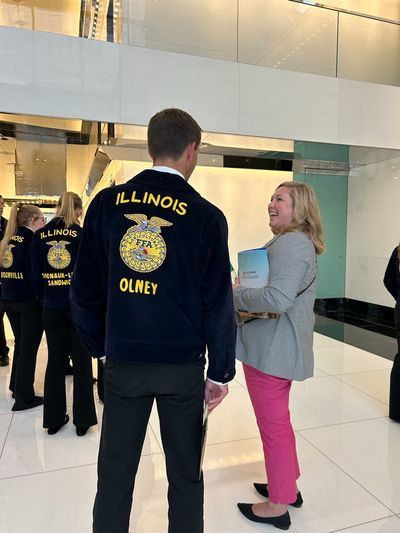
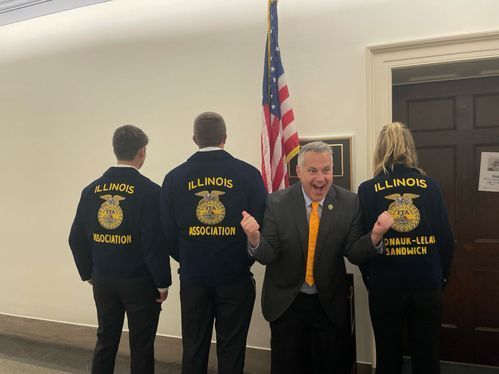
A man in an illinois olney jacket stands next to a woman

This story is a feature article in ICGA's PAC Newsletter: Maize Matters


Blue corduroy jackets were hot and heavy in Washington D.C during July, but Illinois FFA members said they were honored to hold the weight, responsibility, and privilege of representing agriculture alongside the ILCorn Growers Association (ICGA) in the United States capital.
For the 
sixth year, IL Corn partnered with Illinois FFA, inviting state officers and section presidents to Washington D.C. for the National Corn Growers Association’s Corn Congress.


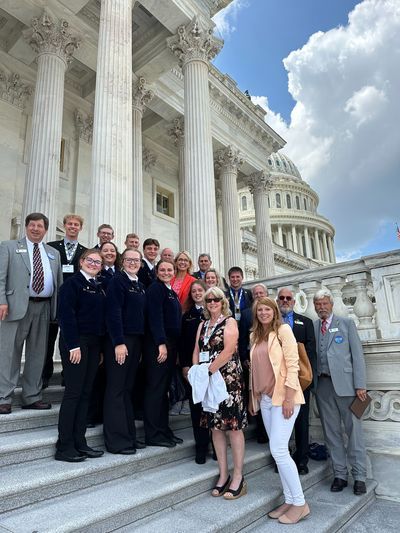
Illinois’ five state FFA major officers and 25 section presidents were given a voice alongside ICGA to discuss federal legislation impacting Illinois farmers. “The people that I got to meet with were in favor of the Farm Bill,” said Samantha Hazelwonder, Illinois FFA’s Section 16 president. “It was amazing to see the amount of support that they have for us, and we have for them.”

Illinois FFA’s trip to Washington D.C. is one piece of IL Corn’s partnership with the organization. In 2023, IL Corn committed to donate $25 to Illinois FFA for each new ICGA membership. At this year’s Illinois FFA State Convention, IL Corn was recognized as one of the organization’s top Star Supporters.


During their time in Washington D.C., officers filled every moment with opportunity, visiting industry leaders, executive departments, and federal legislators. The young leaders asked administrators and policy makers questions about the Farm Bill, atrazine, the Environmental Protection Agency’s (EPA) tailpipe emissions proposal, and the future of the ethanol industry.

A group of people wearing illinois jackets are standing next to each other
A group of people are posing for a picture on the steps of the capitol building.

Hazelwonder said she was able to gain a new perspective during her first trip to Washington. “We got to meet with EPA, U.S. Grains Council, and a bunch of differentpeople. Those (visits) were absolutely amazing to learn from their perspective,” said Hazelwonder. “Not only that, but we also got to learn a little bit about the people speaking to us and how they got to those places, as we look into our future careers.”


Although Capitol Hill was a busy place before August recess, blue jackets were seen alongside ICGA leadersadvocating for legislative priorities in congressional meetings. ICGA leadership met with all 17 Illinois’representatives and both senate offices. Farmer leaders also built relationships with members of congress during the National Corn Growers Association “Farm Bill Frenzy” reception.

“Not only was our July trip to Washington D.C.successful because we advocated for our farmer members, but because we highlighted to the next generation, the impact policy plays in our everyday lives,” said ICGA President Matt Rush, a graduate of Southern IllinoisUniversity Carbondale’s agricultural education program. “Not only was our July trip to Washington D.C.successful because we advocated for our farmer members, but because we highlighted to the next generation, the impact policy plays in our everyday lives,” said ICGA President Matt Rush, a graduate of Southern Illinois University Carbondale’s agricultural education program.


“I had never really had an interest in policy before, nor understood what it was. But coming here, and meeting with all these people has really given me an understanding that I think a lot of people should have,” said Hazelwonder. “So, as I go into my future, when I see those things, I now will understand what’s actually going on and how I can relate to it.”

Lou Lamoreux Farm
By Tara Desmond September 3, 2026
Livestock farmer Lou Lamoreux talks about his farming operation.
captain Cornelius at shake it up cocktail lounge
By Tara Desmond September 3, 2026
4.29M bushels of U.S. corn fueled beverage alcohol production in July 2026 alone — up 54% from July 2025. Corn's in your Labor Day toast!
aerial view of short corn
By Tara Desmond September 3, 2026
Illinois farmer Steve Fourez tests short stature corn against conventional hybrids, exploring yield potential and late-season management benefits.
USDA building
By Lyndi Allen September 3, 2026
This week, U.S. Secretary of Agriculture Brooke L. Rollins announced the U.S. Department of Agriculture (USDA) Data Modernization Plan to put Farmers First, reduce unnecessary burdens on producers, and improve the timeliness, accuracy, and usefulness of the data that informs agricultural decisions. USDA data informs crop and livestock estimates, risk-management tools, disaster assistance, and critical business decisions made by farmers, ranchers, agribusinesses, researchers, and policymakers. In February 2026, Secretary Rollins issued a Request for Information seeking feedback on the opportunities, challenges, and emerging areas in USDA data. That feedback helped shape the USDA Data Modernization Plan and its four pillars: Modernize the Data Reporting Experience: USDA will expand use of administrative data, improve mobile access to surveys, explore opportunities to use prefilled information where appropriate, and strengthen coordination across the Department. These changes will reduce duplicative requests and limit the amount of time producers spend reporting information. Enhance Acreage and Yield Estimation: USDA will conduct a pilot to evaluate the use of improved satellite imagery, geospatial tools, crop models, and other emerging technologies combined with essential producer-reported information to enhance acreage and yield estimations. USDA will also assess the use of optional field inputs to enhance and ground truth yield estimates and continue advancing yield research through collaboration with agricultural partners and land-grant universities. Integrate Data and Technology Platforms: USDA will modernize its technology infrastructure, expand secure data-sharing capabilities, and evaluate the responsible use of tools such as artificial intelligence and machine learning. Better integrated systems will improve efficiency, reduce duplication, and allow USDA to produce more timely and useful information. Expand Trust and Transparency with Producers: USDA will protect producer privacy, clearly explain why information is requested and how it is used, and create additional opportunities for producers to provide feedback. USDA will also improve communication surrounding reports, methodologies, response rates, and data limitations. USDA will begin implementing actions under the plan immediately and will continue engaging farmers, ranchers, and agricultural stakeholders throughout the process. The Department will evaluate new approaches carefully, protect privacy and confidentiality, and publish clear methodologies and supporting information to maintain the integrity of USDA’s agricultural statistics. See USDA’s Full Data Modernization Plan
Cornfield beside a dirt path under a blue sky with wispy clouds
By Lyndi Allen September 2, 2026
EPA has granted 1.76 billion RIN exemptions to small refiners, raising concerns among farmers and biofuel producers about the potential impact on demand for renewable fuel.
Weekly News
By Lyndi Allen August 28, 2026
News from IL Corn for week ending 8/28/26
Show More