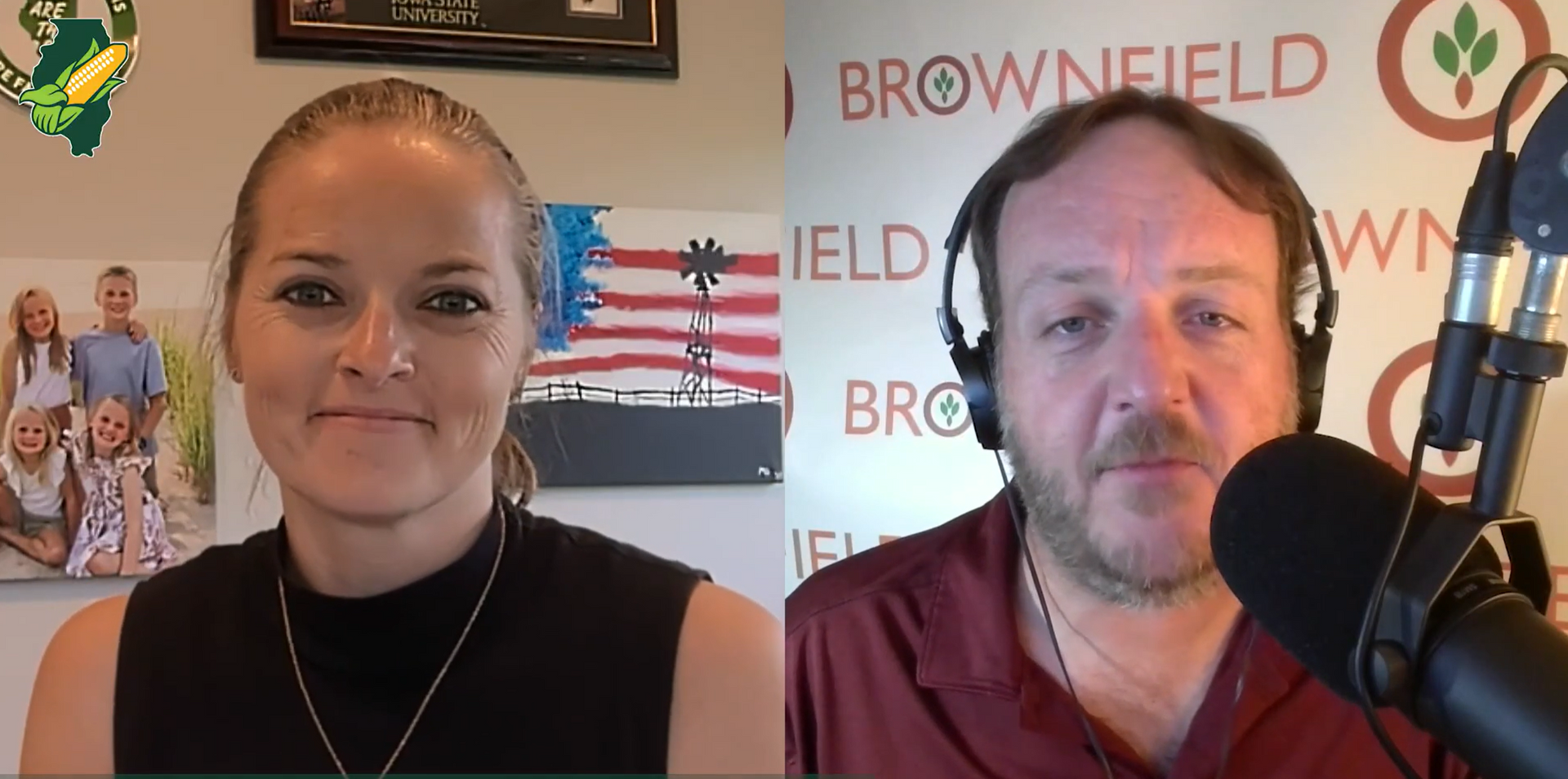
Meet IL Corn Marketing Board Chair Jon Rosenstiel

October 25, 2023

IL Corn is made up of two farmer-led organizations that serve corn farmers in Illinois: IL Corn Growers Association (ICGA) and IL Corn Marketing Board (ICMB).


As the newly appointed board chair of the IL Corn Marketing Board, Jon steps into a pivotal role that holds the key to guiding the organization toward future growth and success in the coming year. With a wealth of experience and a visionary outlook, Jon brings to the position a profound understanding of the challenges and opportunities within the corn industry.


Get to know Jon through a quick Q & A

Q: Can you share a brief overview of your background / farming operation?

Jon: I am the fourth generation to farm our family farm. After getting an Ag Business degree from Illinois State University, I was a Certified Crop Advisor with FS first in Piatt County then in Stephenson County. I was fortunate to be able to farm with my father for 3 years before he passed away, and continued the operation, expanding acres and diversifying into a beef cow/calf program. We currently raise corn, soybeans, and alfalfa. Most of our continuous corn is conventional tilled, while the rotated ground is minimum till or no-till. We have started doing strip till on some of the continuous corn. Soybeans are predominately no-till.


Q: What motivated you to volunteer your time and expertise as a board member for IL Corn?

Jon: I had spent several years on the Stephenson County Soil and Water Conservation Service Board and the Stephenson County Farm Bureau Board when I was approached by Lou Lameroux to see if I was interested in running for the District 2 director position on the IL Corn Marketing Board. It really intrigued me, and as I learned more about the role the Marketing Board plays in managing checkoff dollars, I saw it as an opportunity to be a part of a great organization.


Q: Can you describe a specific project or initiative you're passionate about on ICMB and how you envision it making a positive impact?

Jon: There are actually two areas that have caught my interest. The first is working on ethanol and the role the corn organizations play in promoting, supporting, and expanding the use of ethanol. The second is a new initiative to support community colleges in their role of training, developing, and expanding the agriculture workforce. I see a real opportunity to have an impact on the next generation of agricultural workers and leaders. 


Q: If you were to tell non-board members one thing about the IL Corn Board(s) and what they do, what would it be?

Jon: Marketing, promoting, and representing Illinois corn and farmers is a continuous process that is always changing and facing new challenges. It is very important to keep on top of all that is occurring in order to maintain Illinois corn’s position as a valuable commodity in the U.S. and throughout the world.


Q: What message or advice would you like to convey to young people interested in pursuing a career in farming or agriculture, based on your own experiences and expertise?

Jon: Agriculture offers a wide variety of career paths for anyone that has the passion or desire to be involved. Be prepared to be flexible and open to new opportunities, since the job or career path you start on can lead you in a direction that you never imagined yourself taking.


Q: What is something most people don’t know about you?

Jon: My first real job was as the overnight grain dryer operator of a grain elevator in central Illinois while I was in college.


Learn more about the IL Corn Marketing Board. Want to get involved on a board or committee? E-mail us.

Lou Lamoreux Farm
By Tara Desmond September 3, 2026
Livestock farmer Lou Lamoreux talks about his farming operation.
captain Cornelius at shake it up cocktail lounge
By Tara Desmond September 3, 2026
4.29M bushels of U.S. corn fueled beverage alcohol production in July 2026 alone — up 54% from July 2025. Corn's in your Labor Day toast!
aerial view of short corn
By Tara Desmond September 3, 2026
Illinois farmer Steve Fourez tests short stature corn against conventional hybrids, exploring yield potential and late-season management benefits.
USDA building
By Lyndi Allen September 3, 2026
This week, U.S. Secretary of Agriculture Brooke L. Rollins announced the U.S. Department of Agriculture (USDA) Data Modernization Plan to put Farmers First, reduce unnecessary burdens on producers, and improve the timeliness, accuracy, and usefulness of the data that informs agricultural decisions. USDA data informs crop and livestock estimates, risk-management tools, disaster assistance, and critical business decisions made by farmers, ranchers, agribusinesses, researchers, and policymakers. In February 2026, Secretary Rollins issued a Request for Information seeking feedback on the opportunities, challenges, and emerging areas in USDA data. That feedback helped shape the USDA Data Modernization Plan and its four pillars: Modernize the Data Reporting Experience: USDA will expand use of administrative data, improve mobile access to surveys, explore opportunities to use prefilled information where appropriate, and strengthen coordination across the Department. These changes will reduce duplicative requests and limit the amount of time producers spend reporting information. Enhance Acreage and Yield Estimation: USDA will conduct a pilot to evaluate the use of improved satellite imagery, geospatial tools, crop models, and other emerging technologies combined with essential producer-reported information to enhance acreage and yield estimations. USDA will also assess the use of optional field inputs to enhance and ground truth yield estimates and continue advancing yield research through collaboration with agricultural partners and land-grant universities. Integrate Data and Technology Platforms: USDA will modernize its technology infrastructure, expand secure data-sharing capabilities, and evaluate the responsible use of tools such as artificial intelligence and machine learning. Better integrated systems will improve efficiency, reduce duplication, and allow USDA to produce more timely and useful information. Expand Trust and Transparency with Producers: USDA will protect producer privacy, clearly explain why information is requested and how it is used, and create additional opportunities for producers to provide feedback. USDA will also improve communication surrounding reports, methodologies, response rates, and data limitations. USDA will begin implementing actions under the plan immediately and will continue engaging farmers, ranchers, and agricultural stakeholders throughout the process. The Department will evaluate new approaches carefully, protect privacy and confidentiality, and publish clear methodologies and supporting information to maintain the integrity of USDA’s agricultural statistics. See USDA’s Full Data Modernization Plan
Cornfield beside a dirt path under a blue sky with wispy clouds
By Lyndi Allen September 2, 2026
EPA has granted 1.76 billion RIN exemptions to small refiners, raising concerns among farmers and biofuel producers about the potential impact on demand for renewable fuel.
Weekly News
By Lyndi Allen August 28, 2026
News from IL Corn for week ending 8/28/26
Show More