Protecting Illinois Farmers' Way of Life

September 21, 2023
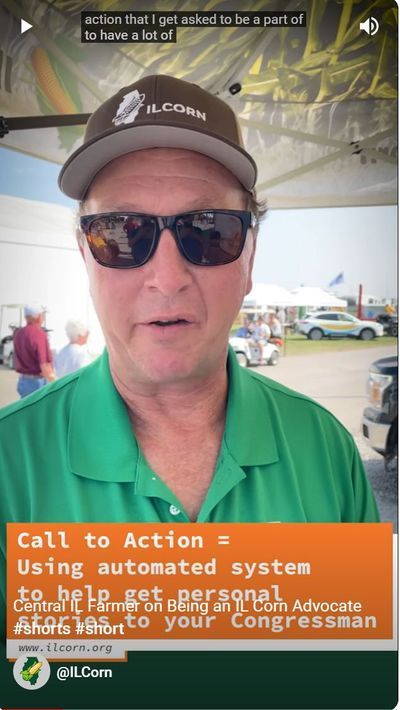
A man wearing sunglasses and a hat says call to action

IL Corn Growers Association is a state-based organization that represents the interests of corn farmers in Illinois by maintaining a high profile on issues in Washington, DC, and Springfield, IL. As a grassroots advocacy group, we strive to engage our members and advocates by sharing news and involvement opportunities that will impact farm families, agribusiness’, and farms overall bottom line. The quickest communication method we use, with the highest response rate is through text messaging farmers in Illinois.
 

The Call-to-Action Process

When a high priority issue is up for vote, or a docket is opened for comments, IL Corn summarizes the issue giving consideration to how it will impact corn farmers in Illinois. This information is then shared in a way that is easy to understand via a link. Staff draft a narrative that’s applicable to IL Corn advocates’ agricultural circumstances sometimes offering a step-by-step question and answer scenario making it an even more personalized submission that automatically gets submitted to either a docket or your congressman.

Only the Most Important Issues

IL Corn's text alert platform is only utilized for the highest priority issues. In 2022, IL Corn only sent six calls to action, so when advocates receive a text, they can be sure that they’re only receiving the most vital requests necessary to incite change. Privacy and security is always a priority of IL Corn. Personal contact information is never shared outside of the organization and they honor all “opt out” requests.
 

Best Practices

Computer programs keep track of constituent engagement in a variety of ways. Congressional offices can flag news articles that mention their elected official or specific topics. Keywords are flagged on social media sites. Personal communication (like our calls-to-action) from constituents are organized by topic and position; the bigger the response, the more congressional staff resources are allocated to that topic. The quality of these messages is also weighted. A more personalized message is considered “more valuable” than a canned message. To grab a staffer’s attention, always make sure to state your name, town, and a bit about your farm or business in the first couple sentences of the message. It takes about 500 “canned” messages to measure up to the value of 100 personalized messages. Personalization is key!
 

The Impact

When a federal agency or Congress hears a similar concern from a substantial number of people, it puts pressure on them to take action. IL Corn has experienced, first-hand, Congressmen and Senators who take direct quotes from our messaging to committee meetings or debates on the floor. On occasion, elected officials will even reach out to constituents to thank them for sharing their experiences and position with them. This is our government operating as it should; citizens exercising their rights and politicians their privileges. IL Corn is honored to assist in this process!


>> Opt in to the text alert system to become an IL Corn Growers Association political advocate << 

Baby with Corn Plastic Food Containers
By Pearl McDade June 12, 2026
Explore how corn is converted into PLA bioplastic for cups, food packaging, and 3D printing as demand grows for sustainable materials.
PCMthumbnail
By Tara Desmond June 11, 2026
PCM's 2026 Data Book, featured in this week's Prairie Farmer, shares 11 years of field data proving conservation and profitability go hand in hand.
By Tara Desmond June 11, 2026
How much do you know about the farmers who came before you and the decisions that still shape Illinois agriculture today? That's what University of Illinois student Lyndon Shi set out to explore during his internship with IL Corn . What began as an archival research project became a deeper look at the history of farmer leadership, innovation and advocacy in Illinois. While digging through university archives, Lyndon uncovered an undigitized manuscript from agricultural economist Harold Guither explaining the case for checkoffs. When he mentioned the discovery to IL Corn Director Rod Weinzierl, he got an unexpected response: "Oh yeah, I know him. We worked with him." It was a reminder that agricultural history isn't as distant as it may seem. Lyndon's research connected two eras of the IL Corn Growers Association: the original organization founded in the 1890s and the modern ICGA established in the 1970s. He learned how University of Illinois agriculture dean Eugene Davenport helped organize corn growers and sent professors across the state on "Corn Gospel Trains" to share the latest farming research. One story stood out in particular: the adoption of hybrid corn. Farmers who once judged corn by the appearance of the ear had to shift their focus to yield. Lyndon sees a similar transition today, as farmers increasingly balance yield with profitability amid rising input costs. "Illinois corn farmers are very good at organizing, and they are genuinely very grassroots," Lyndon said. "They've had a much more active role in shaping policy rather than just being on the receiving end." This Summer and Fall, Lyndon will travel to Taiwan on a federal scholarship to study food security. He'll do so with a new appreciation for Illinois agriculture's global connections, including Taiwan's longstanding role as an important trading partner. Watch the full conversation on IL Corn TV to hear Lyndon's research firsthand and discover how Illinois corn's history continues to influence the future.
Matt at USAPEEC Strategic Conference
By Tara Desmond June 11, 2026
IL Corn director Matt Raben was elected to USAPEEC's executive committee at the organization's 37th Annual Meeting this week.
Green world map with black curved arrows linking North America to Europe and Asia
By Lyndi Allen June 11, 2026
As one of the nation’s top agriculture exporters, Illinois ships corn to buyers across the globe—but where is it all going
Brian
By Tara Desmond June 11, 2026
Funk's Farm manager Brian Bangert explains the farm's 200-year history, the origins of Funk's G Hybrid, and how corn powers their cattle operation today.
Show More