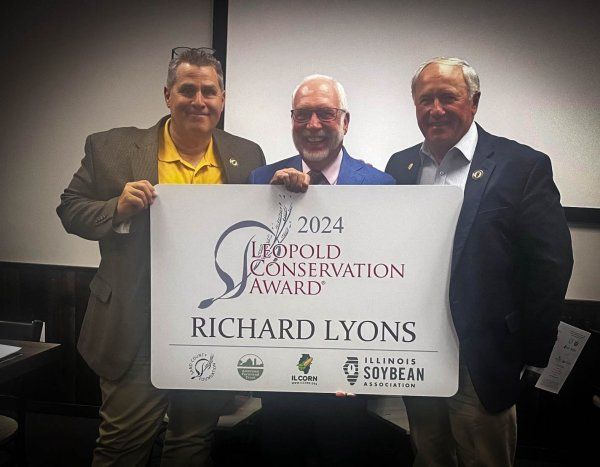
Given in honor of renowned conservationist Aldo Leopold, the award recognizes farmers and forestland owners who inspire others with their dedication to environmental improvement. In his influential 1949 book, A Sand County Almanac, Leopold called for “a land ethic,” an ethical relationship between people and the land they own and manage.
Illinois landowners were encouraged to apply, or be nominated, for the award. Applications were reviewed by an independent panel of agricultural and conservation leaders from Illinois. Among the many outstanding landowners nominated for the award were finalists: Lieb Farms of Monticello in Pitatt County, and Martin Family Farms of Mt. Pulaski in Logan County.
ABOUT RICHARD LYONS
Richard Lyons says his conservation ethic began to evolve shortly after the death of his father.
He began noticing things about the land they had farmed together. Crops wilted sooner over areas of compaction from tractor and truck tires. Water running from grassy areas after heavy rains were free of sediment.
Without a father or grandfather to explain how they had farmed in the past, Richard began farming with an open mind to prevent soil erosion from wind and rain.
With dual careers of farming and teaching agriculture, Richard was in a unique position to give his students first-hand knowledge of what it means to be a conservation-minded farmer. During 37 years as a high school and college agriculture instructor, he taught students what he practiced on his own land.
Early on he retired his moldboard plow and began to chisel plow cornstalks to prevent erosion. In 1976, he also began planting no-till corn into soybean stubble to reduce fuel and labor costs. At that time, research showed that nearby Lake Lou Yaeger was Illinois’ fastest-silting lake. It provides drinking water for 10,000 Montgomery County residents. Determined to be part of the solution, Richard took steps to improve the water quality in a creek that runs through his farm and into Lake Lou Yaeger.
Richard undertook a ditch and streambank stabilization project using large rock to prevent the undercutting and eventual collapse of the streambank where it curves. He installed filter strips to capture runoff between farmland and the creek. These areas provide wildlife habitat in a region primarily used for row crop production. Improved nesting areas support pheasant and quail, and their predator, the coyote, which aids pest control in soybean fields.
In addition to contour planting crops parallel to the filter strips, Richard has targeted nutrient management plans created for his farmland. He conducts soil tests every three years to guide the application of commercial fertilizer using variable rate technology.
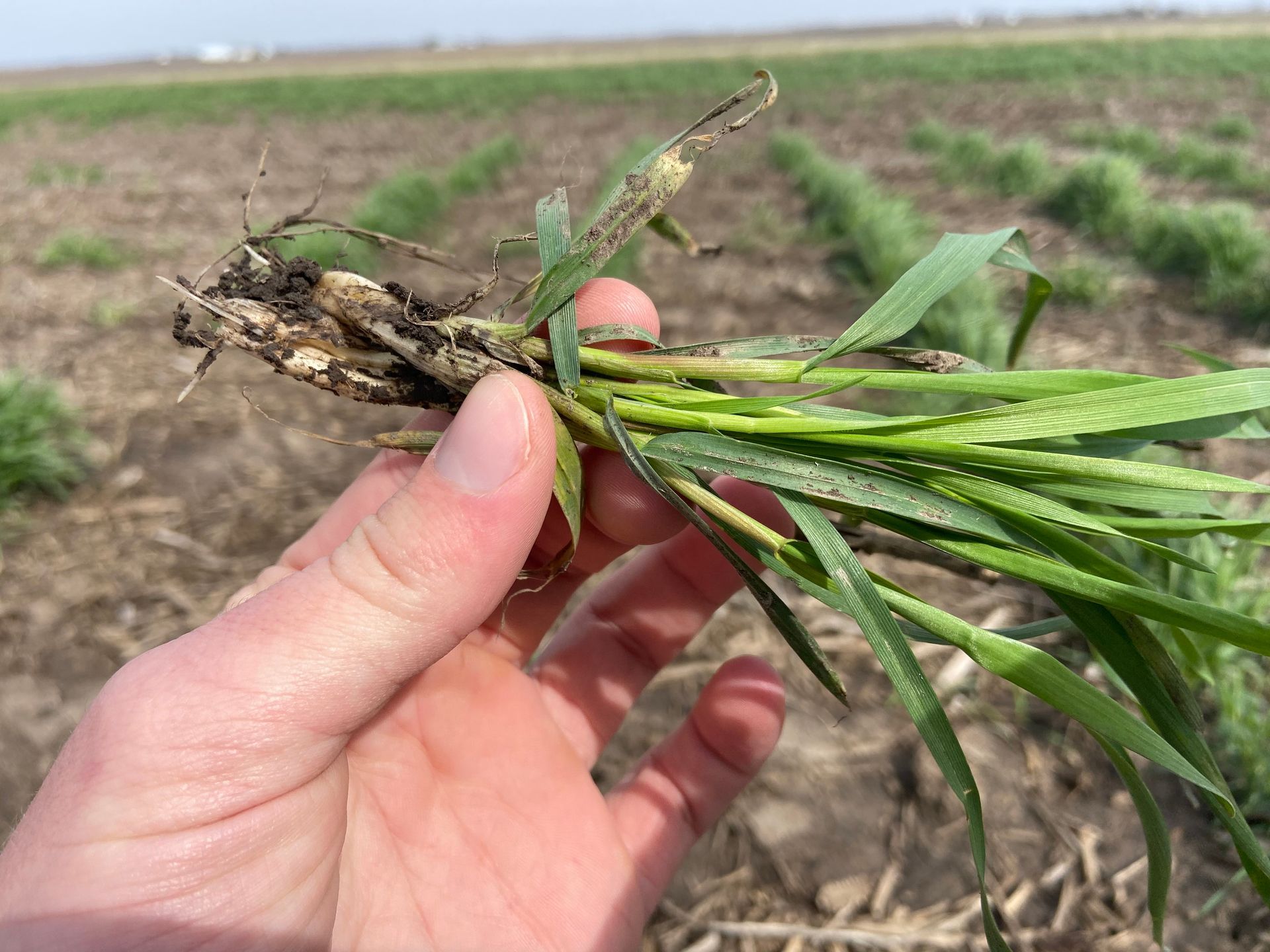
In 2012, Richard began growing deep-rooted cover crops of rye, oats, and radish to improve soil health by encouraging biodiversity, breaking up soil compaction, recycling nutrients, and sequestering carbon. Covering soil with year-round living roots improves water infiltration while preventing erosion. Since 2019, Richard has grown overwintering cover crops of winter barley and Austrian winter peas for their ability to further reduce sediment loss.
Richard initiated a soil health training program by collaborating with individuals from various conservation organizations in Illinois.
This summer he established pollinator-friendly habitat on a two-acre triangular parcel that was difficult to plant with large machinery. These are the latest examples of how Richard’s readiness to embrace new ideas and technologies, while remaining grounded in practical considerations, sets an example for others.
“In my heart and soul, I believe that soil and water conservation on my farm is an ethic that I wish to live by,” Richard said.
ACCOLADES
“As corn farmers, conservation and soil health are the center of our livelihood,” said Jon Rosenstiel, IL Corn Marketing Board Chairman. “Richard Lyons is a prime example of Aldo Leopold’s heart and passion for sustainability. We are happy to highlight his stewardship with this year’s Leopold Conservation Award.”
“The Illinois Soybean Association is proud to recognize Illinois farmers, such as Richard Lyons, who dedicate their time to preserving and improving soil health,” said Ron Kindred, Illinois Soybean Association Chairman. “As implementing conservation practices become more integral to our industry, it’s important that we celebrate those who are leading the charge.”
“Leopold Conservation Award recipients are examples of how Aldo Leopold’s land ethic is alive and well today. Their dedication to conservation shows how individuals can improve the health of the land while producing food and fiber,” said Kevin McAleese, Sand County Foundation President and CEO.
“As the national sponsor for Sand County Foundation’s Leopold Conservation Award, American Farmland Trust celebrates the hard work and dedication of farmers, ranchers and forestland owners,” said John Piotti, AFT President and CEO. “At AFT we believe that conservation in agriculture requires a focus on the land, the practices and the people and this award recognizes the integral role of all three.”
The Illinois Leopold Conservation Award is made possible through the generous support of American Farmland Trust, IL Corn, Illinois Soybean Association, Sand County Foundation, Coleman Family Fund, Farm Credit Illinois, USDA Natural Resources Conservation Service of Illinois, Association of Illinois Soil & Water Conservation Districts, Compeer Financial, Illinois Department of Agriculture, Illinois Sustainable Ag Partnership, and McDonald’s.
For more information on the award, visit www.leopoldconservationaward.org.
# # #
THE LEOPOLD CONSERVATION AWARD
Leopold Conservation Awards recognize landowner achievement in voluntary conservation. Sand County Foundation presents the award in California, Colorado, Illinois, Iowa, Kansas, Kentucky, Maryland, Minnesota, Mississippi, Montana, Nebraska, New Mexico, New York, North Carolina, North Dakota, Oklahoma, Pennsylvania, South Carolina, South Dakota, Texas, Utah, Wisconsin, and in New England (Connecticut, Maine, Massachusetts, New Hampshire, Rhode Island, and Vermont). www.leopoldconservationaward.org
AMERICAN FARMLAND TRUST
American Farmland Trust is the only national organization that takes a holistic approach to agriculture, focusing on the land itself, the agricultural practices used on that land, and the farmers and ranchers who do the work. AFT launched the conservation agriculture movement and continues to raise public awareness through its No Farms, No Food message. Since its founding in 1980, AFT has helped permanently protect over 6.8 million acres of agricultural lands, advanced environmentally sound farming practices on millions of additional acres, and supported thousands of farm families. www.farmland.org
IL CORN is made up of two farmer-led organizations that serve corn farmers in Illinois: IL Corn Growers Association (ICGA) and IL Corn Marketing Board (ICMB). ICGA represents the interests of Illinois corn farmers in Washington, DC and Springfield, IL, while ICMB is focused on growing demand, creating new markets, and fostering understanding of corn farmers and the corn industry. Through these two organizations, IL Corn seeks to position corn farmers to create and capture profit opportunities, preserve their independence, and prosper for generations. www.ilcorn.org
ILLINOIS SOYBEAN ASSOCIATION (ISA) checkoff and membership programs represent more than 43,000 soybean farmers in Illinois. The checkoff funds market development, soybean production and government relations efforts, while the membership program, Illinois Soybean Growers ((ISG) and the Illinois Soybean Growers PAC actively advocates for positive and impactful legislation for farmers at the local, state and national levels. ISA upholds the interests of Illinois soybean farmers through promotion, advocacy, research and education with the vision of becoming a trusted partner of Illinois soybean farmers to ensure their profitability now and for future generations. For more information, visit the website www.ilsoy.org and www.ilsoygrowers.com.
SAND COUNTY FOUNDATION
Sand County Foundation inspires and empowers a growing number of private landowners to ethically manage natural resources in their care, so future generations have clean and abundant water, healthy soil to support agriculture and forestry, plentiful habitat for wildlife and opportunities for outdoor recreation. www.sandcountyfoundation.org