Sen. Duckworth, Ambassador Emanuel, and IL Corn Fuel Big Strides in Japan’s Ethanol Market

March 2, 2023
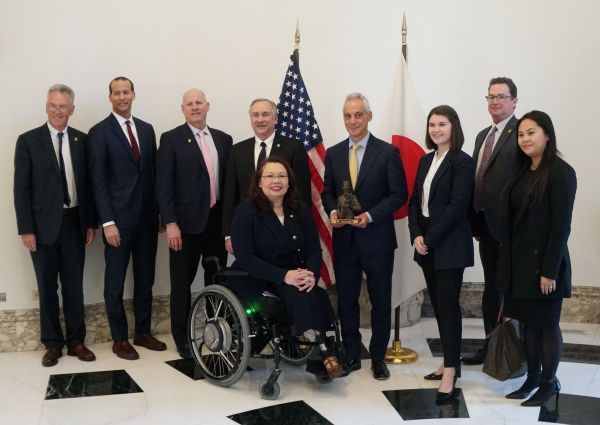
A woman in a wheelchair is standing in front of a group of people

TOKYO, Japan -- Last week, IL Corn leaders joined Sen. Tammy Duckworth (D-IL), and Ambassador Rahm Emanuel, in coordination with the U.S. Grains Council to celebrate a critical win in ongoing efforts to achieve 100 percent access to the Japanese fuel ethanol market for US ethanol.


In 2018, US ethanol entered the Japanese ethanol industry for the first time. Since that time US ethanol has been limited to only 44 percent of the market due to erroneous carbon intensity scoring. IL Corn and its partners at the U.S. Grains Council and other state corn organizations have worked tirelessly over time to demonstrate that US ethanol meets the Japanese government’s carbon intensity criteria. As Japan continues its push to reduce greenhouse gas emissions from the transportation sector, IL Corn anticipates that the country will transition from a 1.9 percent blend to three percent ethanol blends in the next few years.

Throughout 2022, IL Corn supported efforts in coordination with the U.S. Grains Council to address incorrect carbon scores. IL Corn sent technical experts Dr. Steffen Muller, researcher at the University of Illinois at Chicago, and Dr. Michael Wang, a researcher at the Department of Energy’s Argonne National Laboratory, to Tokyo to meet with and educate Japanese regulators, and followed up with another mission that helped address concerns about farming practices and ethanol availability.


The latest mission to Tokyo helped highlight years of effort by the U.S. Grains Council and IL Corn to accurately portray the carbon intensity score of ethanol in the United States. The increase in market access expansion is set to begin in April 2023.


Duckworth and Emanuel have both championed the use of ethanol in the U.S. and abroad. An advocate for the energy diversity and climate-friendly fuel, Duckworth took her message to Japanese government officials and business leaders.


“Throughout my time in Japan, I had great conversations about how we can work together in a mutually beneficial way that would help grow Illinois’ economy, bolster trade between our nations, and support jobs in the agriculture and tech sectors—all while improving our supply chain,” said Duckworth. “Illinois is ready to help bring our world into the future and play a critical role in the expansion of Japan’s ethanol market. I’ll do everything in my power to make sure the whole world knows it.”


Ambassador Emanuel has also worked to expand market access to the U.S. ethanol throughout his tenure in Japan. IL Corn thanked the Ambassador by giving him a bust of Abraham Lincoln in recognition of his contribution to the growing demand for ethanol.


“It was a pleasure to travel to Japan to talk about U.S. ethanol and sit down with someone I’ve known and worked with for years from Illinois,” said Rodney Weinzierl, IL Corn Executive Director. “Ambassador Emanuel’s insight into Japanese political process was impactful to our work there.”


“U.S. corn-based ethanol is a great fit for Japanese climate goals,” said Jeff Scates, IL Corn Director and farmer from Shawneetown, IL. “I’m proud that our Illinois corn checkoff dollars are funding work that helps to update Japanese rules and regulatory processes so that they are more science-based and are using updated models. I saw firsthand how U.S. corn-based ethanol can be a part of the energy solution of the future in Japan.”

If Japan transitions to a 10 percent ethanol blend, the increase represents a potential 1.2-billion-gallon ethanol market.

Lou Lamoreux Farm
By Tara Desmond September 3, 2026
Livestock farmer Lou Lamoreux talks about his farming operation.
captain Cornelius at shake it up cocktail lounge
By Tara Desmond September 3, 2026
4.29M bushels of U.S. corn fueled beverage alcohol production in July 2026 alone — up 54% from July 2025. Corn's in your Labor Day toast!
aerial view of short corn
By Tara Desmond September 3, 2026
Illinois farmer Steve Fourez tests short stature corn against conventional hybrids, exploring yield potential and late-season management benefits.
USDA building
By Lyndi Allen September 3, 2026
This week, U.S. Secretary of Agriculture Brooke L. Rollins announced the U.S. Department of Agriculture (USDA) Data Modernization Plan to put Farmers First, reduce unnecessary burdens on producers, and improve the timeliness, accuracy, and usefulness of the data that informs agricultural decisions. USDA data informs crop and livestock estimates, risk-management tools, disaster assistance, and critical business decisions made by farmers, ranchers, agribusinesses, researchers, and policymakers. In February 2026, Secretary Rollins issued a Request for Information seeking feedback on the opportunities, challenges, and emerging areas in USDA data. That feedback helped shape the USDA Data Modernization Plan and its four pillars: Modernize the Data Reporting Experience: USDA will expand use of administrative data, improve mobile access to surveys, explore opportunities to use prefilled information where appropriate, and strengthen coordination across the Department. These changes will reduce duplicative requests and limit the amount of time producers spend reporting information. Enhance Acreage and Yield Estimation: USDA will conduct a pilot to evaluate the use of improved satellite imagery, geospatial tools, crop models, and other emerging technologies combined with essential producer-reported information to enhance acreage and yield estimations. USDA will also assess the use of optional field inputs to enhance and ground truth yield estimates and continue advancing yield research through collaboration with agricultural partners and land-grant universities. Integrate Data and Technology Platforms: USDA will modernize its technology infrastructure, expand secure data-sharing capabilities, and evaluate the responsible use of tools such as artificial intelligence and machine learning. Better integrated systems will improve efficiency, reduce duplication, and allow USDA to produce more timely and useful information. Expand Trust and Transparency with Producers: USDA will protect producer privacy, clearly explain why information is requested and how it is used, and create additional opportunities for producers to provide feedback. USDA will also improve communication surrounding reports, methodologies, response rates, and data limitations. USDA will begin implementing actions under the plan immediately and will continue engaging farmers, ranchers, and agricultural stakeholders throughout the process. The Department will evaluate new approaches carefully, protect privacy and confidentiality, and publish clear methodologies and supporting information to maintain the integrity of USDA’s agricultural statistics. See USDA’s Full Data Modernization Plan
Cornfield beside a dirt path under a blue sky with wispy clouds
By Lyndi Allen September 2, 2026
EPA has granted 1.76 billion RIN exemptions to small refiners, raising concerns among farmers and biofuel producers about the potential impact on demand for renewable fuel.
Weekly News
By Lyndi Allen August 28, 2026
News from IL Corn for week ending 8/28/26
Show More