
Trade Talk: High Exports, Low Prices

Lyndi Allen
October 30, 2025

High Export Volumes, Low Farm Returns

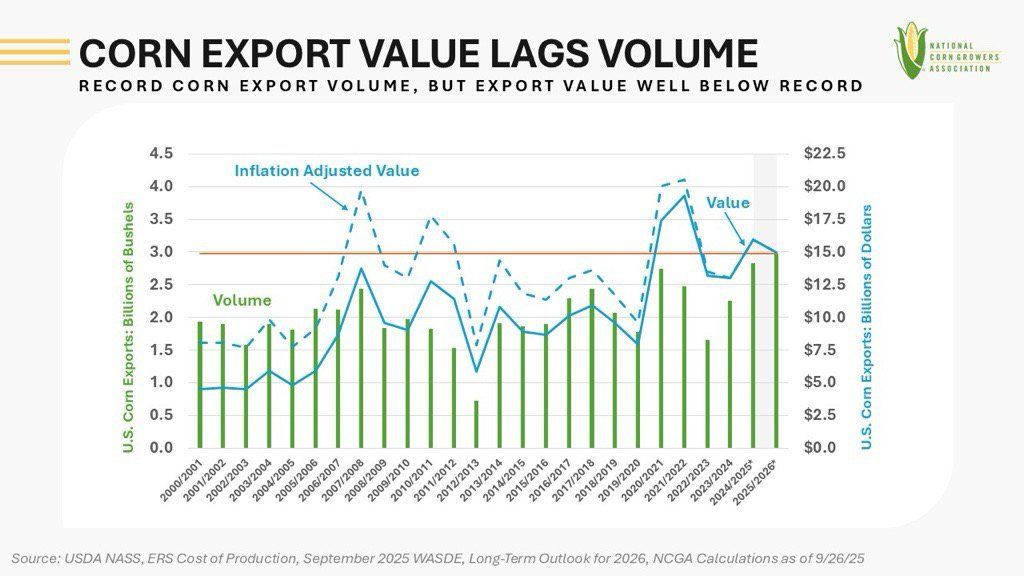
Corn exports continue to increase at record high volumes, but the value is at a stark low. Burdensome global supplies of corn have weighed on markets. Despite the strong export demand, the average price of corn received by Illinois farmers in marketing year 2024/2025 decreased $0.16 per bushel from marketing year 2023/2024—a four percent decrease.


U.S. corn remains competitive in the global market, but its value has not been sufficient enough to cover farmers' expenses. Farmers are still facing high input costs that haven’t returned to pre-pandemic levels, making the current price decline especially painful.

World Agricultural Supply and Demand Estimates (WASDE) are on hold due to the government shutdown. Once those reports are released, corn prices may shift. Until we can read the WASDE report again, investigate corn and corn co-product exports for yourself using the U.S. Grains and BioProducts Council’s tool.


As it stands now, U.S. corn exports are expected to be another record-setting volume at 2.97 billion bushels for the 2025/2026 marketing year, compared to the 2024/2025 record at 2.83 billion bushels. Despite a high expected volume of 2025/2026, the expected value is lower at $14.9 billion, compared to 2024/2025 exports at $15.9 billion.

Graph: Corn export volume vs. value. Volume (bars) higher than value (dashed line) from 2007-2023.

Illinois exports a larger share of its corn than most other Midwestern states—about 30% of our corn crop is destined for foreign markets. A significant portion of our ethanol, dried distiller's grain solubles (DDGS), and pork production leaves the state as well. Illinois’ natural resources and infrastructure help make us a top origin for foreign and domestic shipments.


Lower crop values are hindering farmers' ability to profit despite the export market demand. Farmers need competitive, market-driven demand to provide outlets for corn at profitable prices. Opportunities to grow demand must include high-volume markets that will lead to a significant enough demand to increase corn prices. A domestic opportunity to drive demand is expanding the use of higher ethanol blends, including passing legislation like the Nationwide Consumer and Fuel Retailer Choice Act of 2025 (year-round E15).


IL Corn continues to push Congress to pass legislation that will benefit corn farmers, despite the government shutdown. We will continue to monitor the effects of the government shutdown on farmers as well as legislative opportunities to drive U.S. corn demand. 

collage of pics of Chris Gould
By Tara Desmond February 5, 2026
Former Navy fighter pilot Chris Gould shares how military leadership, sustainability, and teamwork shape success on his Illinois corn farm.
graphic of where IL Corn goes
By Tara Desmond February 5, 2026
Illinois corn farmers invest checkoff dollars with one goal in mind: creating long-term value for every bushel grown.
Split image: Left side, Illinois Capitol Building. Right side, US Capitol Building at sunrise.
By Lyndi Allen February 4, 2026
IL Corn Announces 2026 State and Federal Legislative Priorities. ICGA is advocating for demand growth and family farm profitability to create a successful future for Illinois farmers.
women in ag panel
By Tara Desmond February 4, 2026
Leaders from finance, farming, and ag retail share honest insights on change, consolidation, technology, and relationships shaping agriculture’s future.
North America map with handshake logo, flags of Canada, USA, and Mexico, with corn.
By Lyndi Allen February 4, 2026
USMCA is a free trade agreement to benefit North Americans. This agreement is vital for U.S. corn farmers as Mexico is the #1 export market for corn and Canada is the #1 export market for ethanol.
Corn field under a vibrant orange sunset.
By Lindsay Croke February 3, 2026
Upon the U.S. Treasury’s release of the long-awaited proposed final regulation for the 45Z Clean Fuel Production Tax Credit, IL Corn is pleased to see future opportunities for farmer participation
Show More