For decades, America’s inland waterways operated on a system that couldn’t keep up—aging infrastructure, delayed projects, and a funding model that forced farmers and shippers to wait. Moving grain efficiently downriver wasn’t just about logistics—it was about global competitiveness.
That began to change when the agriculture industry, transportation industry and sustainability interests aligned around one mission: modernize the system and fix how it’s funded.
Progress on major construction projects moved slowly, and critical improvements were often delayed because available funding could not keep pace with the scale of need.
From the 1980s, when our lock and dam system reached its intended lifespan, until the early 2010s, farmers called for Illinois and Mississippi River transportation modernization, including larger and longer lock chambers to accommodate the size of today’s barge tows. Progress began around 2014 with the passage of the
Water Resources Reform and Development Act.
One significant reform in this 2014 bill included a restructuring of the cost-share formula for major lock and dam construction projects to 85% federal funding and 15% from the Inland Waterways Trust Fund. The goal was to protect the industry funding in the IWTF, a goal that is still prioritized today.
Prior to WRRDA 2014, new construction and major rehabilitation projects were funded through a 50/50 split between the federal government and the Inland Waterways Trust Fund, which is supported by the diesel fuel tax paid by commercial barge operators. While the system provided dedicated funding, the shared structure often limited how quickly projects could advance.
WRRDA 2014 changed that model by shifting project costs to 85% federal funding and 15% from the Inland Waterways Trust Fund for qualifying construction and rehabilitation projects. This adjustment reduced financial strain on the trust fund and allowed more projects to move forward more efficiently.
The legislation also increased the barge fuel tax from 20 cents to 29 cents per gallon through the “ABLE Act,” ensuring additional long-term investment into the system. Together, these reforms represented one of the most substantial changes to inland waterways funding in decades.
Over the years, the cost share formula has changed, but has never returned to the old 50/50 model. Olmsted Lock and Dam on the Ohio River near Southern Illinois has been completed, and ground has broken on the Illinois River’s Lock 25 in Calhoun and Lincoln County.
While this progress and these investments are essential, especially for Illinois farmers who need to grow demand and remain competitive in international markets, it isn’t fast enough.
From 2007 to 2016, the Panama Canal conducted a significant expansion, upgrading its system to allow the larger neopanamax vessels to travel through a new set of larger locks and a deeper canal. In the same amount of time, the U.S. has not been able to complete even one new lock and dam, making competition in an international marketplace very difficult.
Every improvement to the river system strengthens demand for corn, lowers transportation costs, and keeps U.S. agriculture competitive. IL Corn Growers Association continues to advocate for the river infrastructure upgrades that will enhance profitability for Illinois farm families.
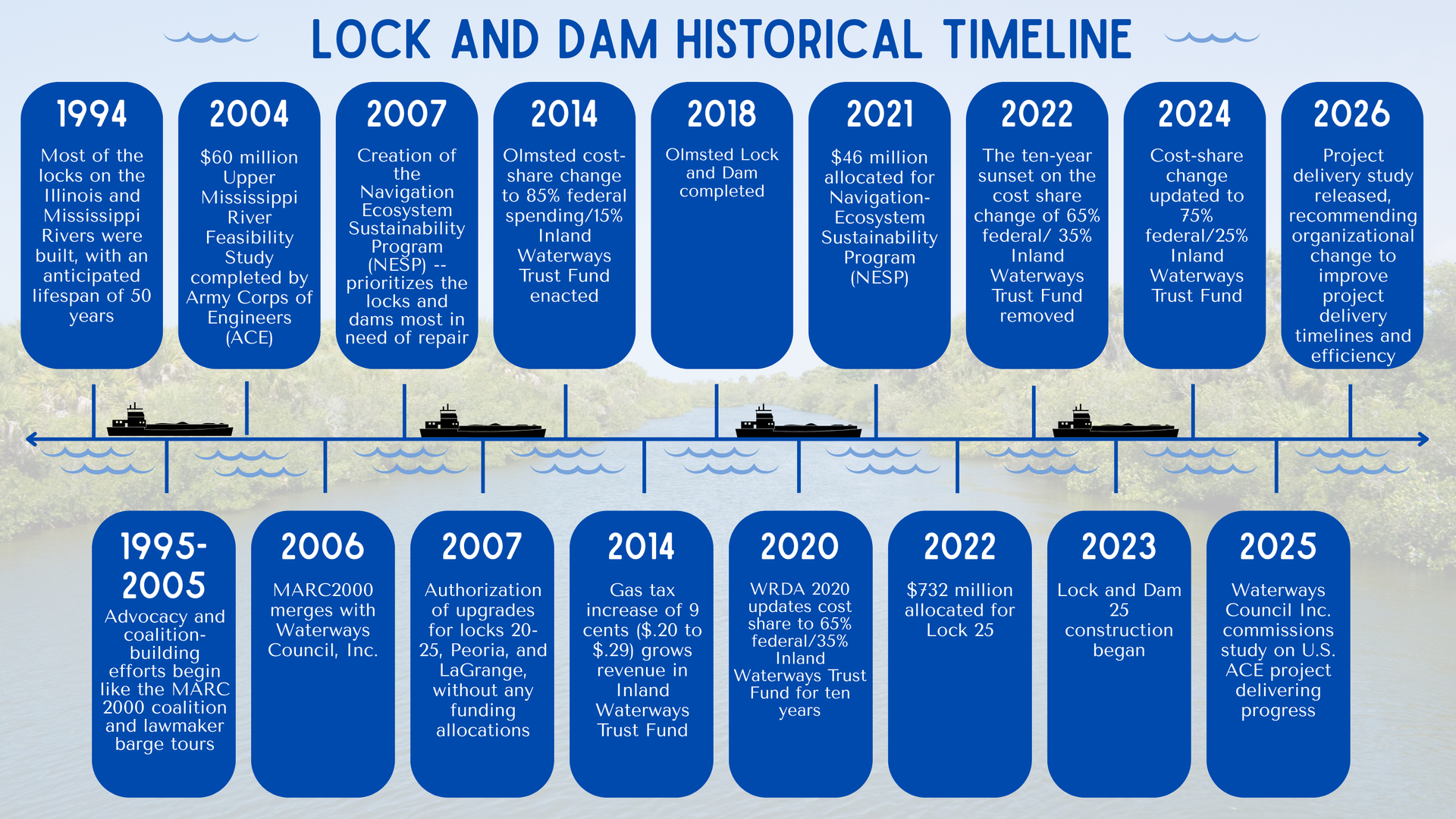
- 1930s – Most of the locks on the Illinois and Mississippi Rivers were built, with an anticipated lifespan of 50 years
- 1994-2005 – Advocacy and coalition-building efforts begin like the MARC 2000 coalition and lawmaker barge tours
- 2004 – $60 million Upper Mississippi River Feasibility Study completed by Army Corps of Engineers (ACE)
- 2006 – MARC2000 merges with Waterways Council, Inc
- 2007 – Creation of the Navigation Ecosystem Sustainability Program (NESP) which prioritizes the locks and dams most in need of repair; ACE will allocate funding accordingly
- 2007 – Authorization of upgrades for locks 20-25, Peoria, and LaGrange, without any funding allocations
- 2014 – Olmsted cost-share change to 85% federal spending/15% Inland Waterways Trust Fund enacted
- 2014 – Gas tax increase of 9 cents ($.20 to $.29) grows revenue in Inland Waterways Trust Fund
- 2018 – Olmsted Lock and Dam completed
- 2020 – WRDA 2020 updates cost share to 65% federal/35% Inland Waterways Trust Fund for ten years
- 2021 – $46 million allocated for Navigation-Ecosystem Sustainability Program (NESP)
- 2022 – $732 million allocated for Lock 25
- 2022 – The ten-year sunset on the cost share change of 65% federal/ 35% Inland Waterways Trust Fund removed
- 2023 – Lock and Dam 25 construction began
- 2024 – Cost-share change updated to 75% federal/25% Inland Waterways Trust Fund
- 2025 – Waterways Council Inc. commissions study on U.S. ACE project delivering progress
- 2026 – Project delivery study released, recommending organizational change to improve project delivery timelines and efficiency