IL Corn Internships Deliver Invaluable Skills and Insights to the Next Generation
Brianna Croft
July 27, 2023

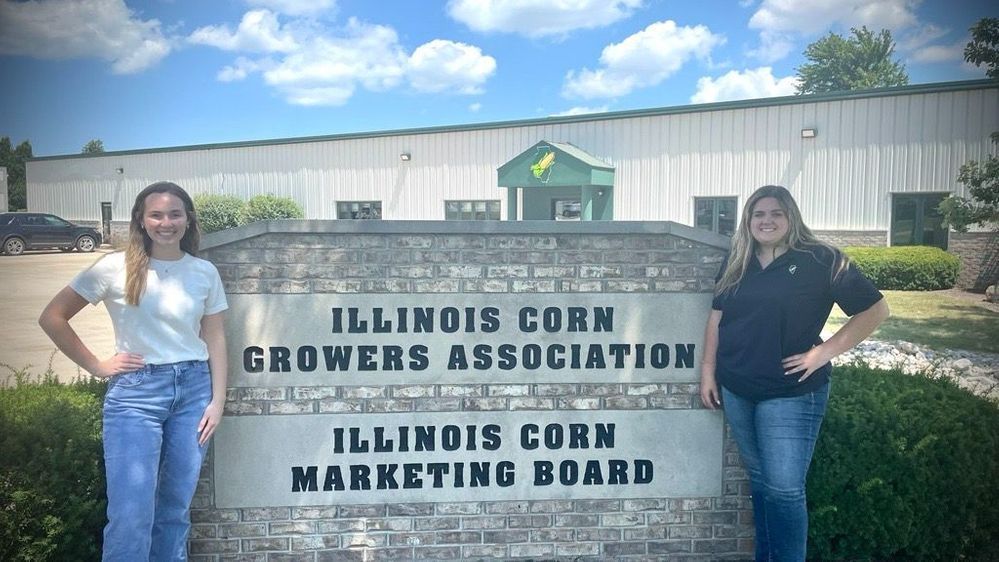
IL Corn offers a summer intern program, Brianna Croft and Emily Bruch joined the small team by assisting the legislative, communications and marketing departments. Through real world experiences offered through these internships, IL Corn helps educate the next generation and develop the future of agriculture. Here’s what each intern learned over the past couple months.
Brianna Croft – Legislative Intern
- Locks and Dams
- Locks and Dams are a huge priority for IL Corn, and she was able to see firsthand the impact our waterways have on farmers when exporting their corn. She visited two drained lock locations and had the opportunity to learn the importance of updating the infrastructure to be more reliable and efficient.
- Washington D.C.
- As part of the legislative internship, Brianna helped to plan and attend Washington D.C. with ICGA. She coordinated meetings with 17 Congressional offices and both Senate offices for IL FFA State Officers and Section Presidents as well as ICGA and ICMB Directors to advocate for corn priorities.
- Ethanol
- Ethanol is a major marketplace for corn. There are many pieces of legislation on the table regarding ethanol production. Brianna has aided the Legislative team by writing summary analysis papers that give an overview of priority legislation at both the State and Federal Level. She has also taken this knowledge learned from reading these pieces, to further be an advocate in Washington D.C.
Emily Bruch – Marketing & Communications Intern
- Ag in the Classroom
- The education of agriculture and corn is important in developing the future of ag. This summer, Emily traveled across Illinois to deliver presentations to teachers regarding ways they can incorporate the various aspects of corn into their education.
- Farm Progress Show
- The Farm Progress show is a widely attended event that displays the future of agriculture. Emily has helped plan and prepare for this year’s Farm Progress Show by organizing and ordering products that will be used on display.
- Precision Conservation Management Program (PCM)
- PCM is a program that combines precision technology and data management with farm business and financials to help farmers. Emily has worked closely with them to create social media and recruitment materials for each individual specialist to use to help recruit farmers into the program and bring attention to the opportunities this program provides.
By Lyndi Allen
•
September 3, 2026
This week, U.S. Secretary of Agriculture Brooke L. Rollins announced the U.S. Department of Agriculture (USDA) Data Modernization Plan to put Farmers First, reduce unnecessary burdens on producers, and improve the timeliness, accuracy, and usefulness of the data that informs agricultural decisions. USDA data informs crop and livestock estimates, risk-management tools, disaster assistance, and critical business decisions made by farmers, ranchers, agribusinesses, researchers, and policymakers. In February 2026, Secretary Rollins issued a Request for Information seeking feedback on the opportunities, challenges, and emerging areas in USDA data. That feedback helped shape the USDA Data Modernization Plan and its four pillars: Modernize the Data Reporting Experience: USDA will expand use of administrative data, improve mobile access to surveys, explore opportunities to use prefilled information where appropriate, and strengthen coordination across the Department. These changes will reduce duplicative requests and limit the amount of time producers spend reporting information. Enhance Acreage and Yield Estimation: USDA will conduct a pilot to evaluate the use of improved satellite imagery, geospatial tools, crop models, and other emerging technologies combined with essential producer-reported information to enhance acreage and yield estimations. USDA will also assess the use of optional field inputs to enhance and ground truth yield estimates and continue advancing yield research through collaboration with agricultural partners and land-grant universities. Integrate Data and Technology Platforms: USDA will modernize its technology infrastructure, expand secure data-sharing capabilities, and evaluate the responsible use of tools such as artificial intelligence and machine learning. Better integrated systems will improve efficiency, reduce duplication, and allow USDA to produce more timely and useful information. Expand Trust and Transparency with Producers: USDA will protect producer privacy, clearly explain why information is requested and how it is used, and create additional opportunities for producers to provide feedback. USDA will also improve communication surrounding reports, methodologies, response rates, and data limitations. USDA will begin implementing actions under the plan immediately and will continue engaging farmers, ranchers, and agricultural stakeholders throughout the process. The Department will evaluate new approaches carefully, protect privacy and confidentiality, and publish clear methodologies and supporting information to maintain the integrity of USDA’s agricultural statistics. See USDA’s Full Data Modernization Plan