

Illinois Farmers Council looks ahead at the future of agriculture

August 3, 2023
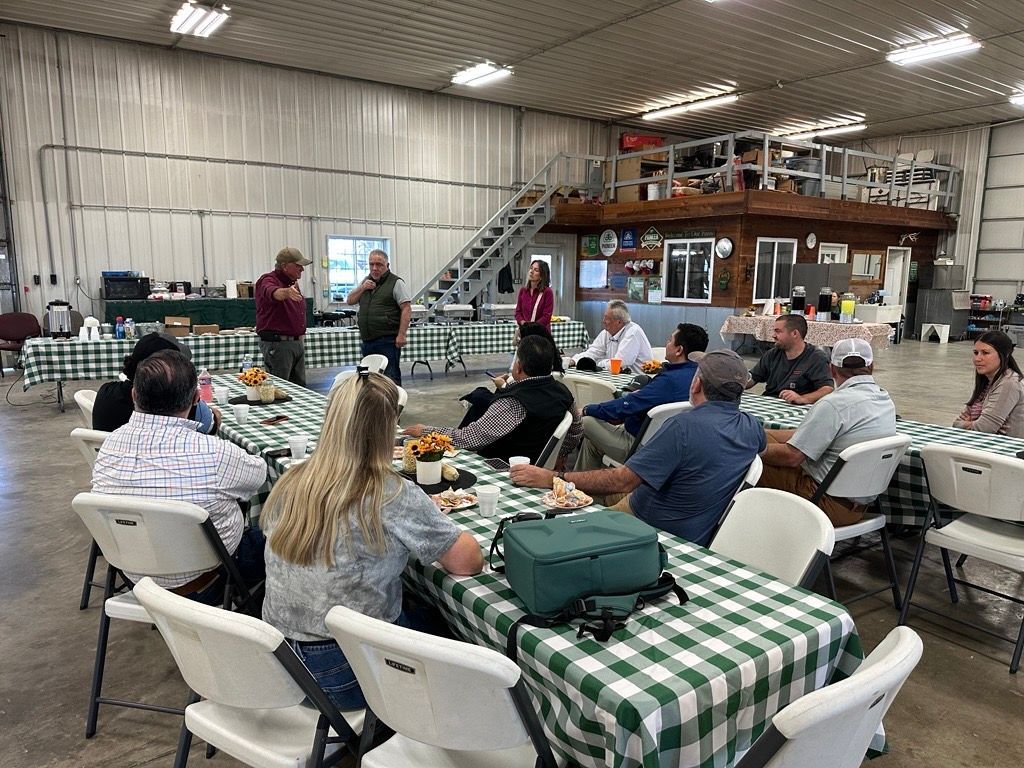
A large group of people are sitting at tables in a conference room.

Yesterday, the IL Corn Growers Association teamed up with agricultural organizations throughout the state to discuss emerging markets and legislation impacting the industry. 


The 2023 Future of Agriculture Forum was hosted by the Illinois Farmers Council, a coalition of ag-related groups, at Richmond Community College in Decatur, Illinois.


“As a united council for agriculture in Illinois, we are looking at future opportunities for our industry,” said President of the Illinois Farmers Council and IL Corn Growers Association Matt Rush. “Our goal was to bring together leaders in each commodity to discuss what is affecting us now and will affect us in years to come.”

The event featured speakers on the science of carbon capture and storage (CCS), market pathways for biofuels, and the Supreme Court’s decisions on the Waters of the United States and Proposition 12.


Farmer leaders and experts evaluated the impact the Supreme Court’s ruling on the National Pork Producers Council v. Ross will have on livestock and grain production. The case, based on a California ballot proposal titled “Proposition 12”, places stricter housing requirements for eggs, veal, and pork sold in California.


Central Illinois hog farmer and President of the Illinois Pork Producers Association Chad Leman said to meet California’s pork demand under the new requirements, approximately 350,000 sows in the United States will need to change confinement. “This goes far beyond hog production,” said Leman. “It will affect corn producers and soybean producers.”

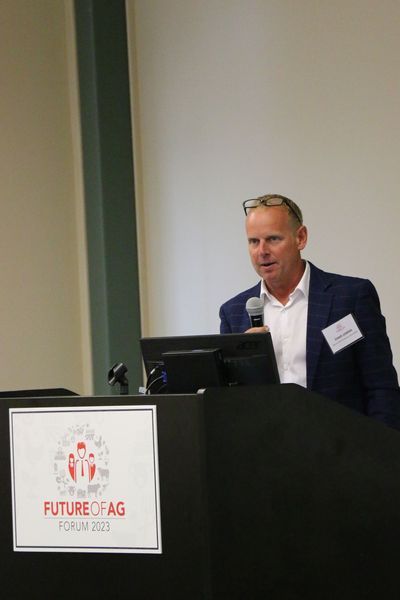
A man is standing at a podium giving a presentation.
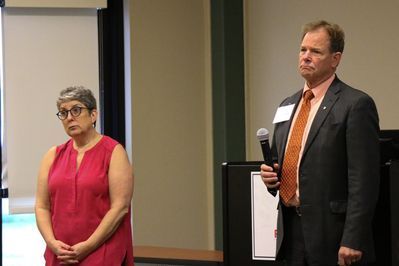
A man in a suit and tie is holding a microphone while standing next to a woman in a red shirt.

Leman said his operation markets 110,000 pigs per year and feeds 80-90 million pounds of feed. “We know quite a bit of that is grown here, among our Illinois producers.” He said as producers look to potentially downsize their herds to meet Proposition 12 requirements it will affect pork producer’s demand of corn and soybeans.


In addition to Supreme Court discussions, panelist Dr. Sallie Greenberg educated the council on the CCS process and its ability to positively impact the ethanol industry. She explained the science and safety of the two CCS projects in Decatur, the Illinois Industrial Carbon Capture and Storage project, and the Illinois Basin- Decatur Project.

Greenberg said in Decatur, CO2 is injected approximately 6,700 feet beneath the surface in a layer of shale 450 feet thick. “Collectively between the two projects there’s about 4 million tonnes of carbon dioxide stored,” said Greenberg.


Archer Daniel Midland (ADM) is a partner in the Illinois Basin- Decatur Project. The company began sequestering carbon in 2001 with carbon dioxide from its ethanol fermentation process. Panelist and Vice President of State Government Relations for ADM Greg Webb said the technology brings a bright future to agriculture.


“We have a vast opportunity in the area of agriculture to meet the carbon intensity aspirations of our consumers,” said Webb. “I believe sincerely that the carbon capture and storage holds a considerable opportunity for our agriculture industry.”


The Illinois Farmers Council is a group of agriculture-related associations from across the state representing farm families, commodities, and the livestock industry. The group is composed of the IL Corn Growers Association, Illinois Farm Bureau, Illinois Soybean Association, Illinois Beef Association, Illinois Pork Association, and the Illinois Milk Producers Association. 

Lou Lamoreux Farm
By Tara Desmond September 3, 2026
Livestock farmer Lou Lamoreux talks about his farming operation.
captain Cornelius at shake it up cocktail lounge
By Tara Desmond September 3, 2026
4.29M bushels of U.S. corn fueled beverage alcohol production in July 2026 alone — up 54% from July 2025. Corn's in your Labor Day toast!
aerial view of short corn
By Tara Desmond September 3, 2026
Illinois farmer Steve Fourez tests short stature corn against conventional hybrids, exploring yield potential and late-season management benefits.
USDA building
By Lyndi Allen September 3, 2026
This week, U.S. Secretary of Agriculture Brooke L. Rollins announced the U.S. Department of Agriculture (USDA) Data Modernization Plan to put Farmers First, reduce unnecessary burdens on producers, and improve the timeliness, accuracy, and usefulness of the data that informs agricultural decisions. USDA data informs crop and livestock estimates, risk-management tools, disaster assistance, and critical business decisions made by farmers, ranchers, agribusinesses, researchers, and policymakers. In February 2026, Secretary Rollins issued a Request for Information seeking feedback on the opportunities, challenges, and emerging areas in USDA data. That feedback helped shape the USDA Data Modernization Plan and its four pillars: Modernize the Data Reporting Experience: USDA will expand use of administrative data, improve mobile access to surveys, explore opportunities to use prefilled information where appropriate, and strengthen coordination across the Department. These changes will reduce duplicative requests and limit the amount of time producers spend reporting information. Enhance Acreage and Yield Estimation: USDA will conduct a pilot to evaluate the use of improved satellite imagery, geospatial tools, crop models, and other emerging technologies combined with essential producer-reported information to enhance acreage and yield estimations. USDA will also assess the use of optional field inputs to enhance and ground truth yield estimates and continue advancing yield research through collaboration with agricultural partners and land-grant universities. Integrate Data and Technology Platforms: USDA will modernize its technology infrastructure, expand secure data-sharing capabilities, and evaluate the responsible use of tools such as artificial intelligence and machine learning. Better integrated systems will improve efficiency, reduce duplication, and allow USDA to produce more timely and useful information. Expand Trust and Transparency with Producers: USDA will protect producer privacy, clearly explain why information is requested and how it is used, and create additional opportunities for producers to provide feedback. USDA will also improve communication surrounding reports, methodologies, response rates, and data limitations. USDA will begin implementing actions under the plan immediately and will continue engaging farmers, ranchers, and agricultural stakeholders throughout the process. The Department will evaluate new approaches carefully, protect privacy and confidentiality, and publish clear methodologies and supporting information to maintain the integrity of USDA’s agricultural statistics. See USDA’s Full Data Modernization Plan
Cornfield beside a dirt path under a blue sky with wispy clouds
By Lyndi Allen September 2, 2026
EPA has granted 1.76 billion RIN exemptions to small refiners, raising concerns among farmers and biofuel producers about the potential impact on demand for renewable fuel.
Weekly News
By Lyndi Allen August 28, 2026
News from IL Corn for week ending 8/28/26
Show More