IL CORN: VALUED PARTNER IN TWO USDA FUNDED CLIMATE-SMART PROPOSALS

September 14, 2022
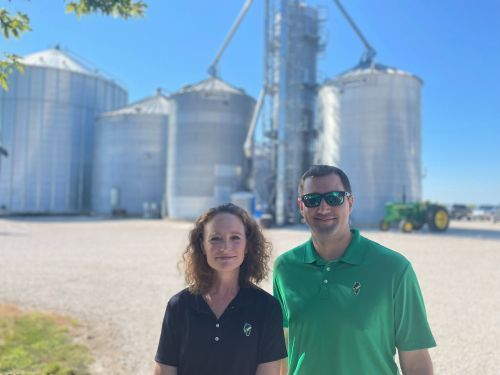
A man and a woman are standing in front of a grain silo.

BLOOMINGTON, Ill. – Today, IL Corn celebrates being named as a valued partner in multiple projects funded by the United States Department of Agriculture (USDA) Partnerships for Climate-Smart Commodities program.


Farmers for Soil Health

Funded at $95 million, the Farmers for Soil Health (FSH) project will incentivize farmers to plant additional acres of cover crops. The FSH collaboration includes soy checkoff, Pork Checkoff, National Corn Growers Association and American Soybean Association, resulting in a farmer-led cover crop program that advances the use of soil health practices, meets sustainability goals, and improves farmer profitability.

FSH’s goal is to encourage farmers to expand their adoption of cover crops to 30 million acres by 2030. IL Corn along with Illinois Soybean Association (ISA) and the Illinois Pork Producers Association - are partners in this project via their national associations, but also look forward to contributing the direct farmer conversation and mentorship that will empower the additional planting of cover crops in Illinois.


Field to Market

A second climate-smart proposal by Field to Market is funded at $70 million and includes the Precision Conservation Management (PCM) program as a valued partner. PCM is a premiere conservation program offered by IL Corn and ISA, providing conservation adoption advice and reviewing financial outcomes from conservation adoption. PCM looks forward to being the partner that will interface with Illinois farmers to deliver innovative financial initiatives to increase conservation adoption.

“PCM is excited to be able to expand on our partnership with Field to Market and leverage the funding from USDA and private sources to help farmers ‘de-risk’ their conservation decisions,” said PCM Director Greg Goodwin. “PCM will continue to be a trusted partner to farmers in this conservation space and this funding will empower us to grow our offerings to farmers and build relationships that will bring about valuable conservation outcomes.”

“Via a letter of support, IL Corn promised an additional $100,000 of funding and $50,000 of in-kind services for the Field to Market Innovative Finance Initiative project. We are heavily invested in climate-smart programs, vetted by farmers and workable for farmers,” said IL Corn Growers Association President Marty Marr, a farmer from New Berlin, IL.

“The transition to climate-smart agricultural practices is a journey that many farmers cannot undertake alone,” said Field to Market President Scott Herndon. “We are incredibly grateful to be selected as a recipient of this funding, as it allows us to increase the availability of innovative strategies that reduce the financial and agronomic risks for farmers in adopting climate-smart practices.”

Out of an original budget of $1 billion, the USDA Partnerships for Climate-Smart Commodities program awarded $2.8 billion in grants to 70 selected collaborative projects and partnerships. Ultimately, USDA’s anticipated investment will triple to more than $3 billion in pilots that will create market opportunities for American commodities produced using climate-smart production practices. These initial projects will expand markets for climate-smart commodities, leverage the greenhouse gas benefits of climate-smart commodity production and provide direct, meaningful benefits to production agriculture, including for small and underserved farmers.

###

About the IL Corn Growers Association
IL Corn Growers Association is one of two parts that make up IL Corn. This is a state-based organization that represents the interests of corn farmers in Illinois, maintaining a high profile on issues in Washington, DC, and Springfield, IL. Through grassroots advocacy, ICGA creates a future for Illinois farmers in which they can operate freely, responsibly, and successfully. In order to fulfill this mission, the organization conducts governmental affairs activities at all levels, market development projects, and educational and member service programs. For further information regarding their work and involvement, 
visit their website.

Lou Lamoreux Farm
By Tara Desmond September 3, 2026
Livestock farmer Lou Lamoreux talks about his farming operation.
captain Cornelius at shake it up cocktail lounge
By Tara Desmond September 3, 2026
4.29M bushels of U.S. corn fueled beverage alcohol production in July 2026 alone — up 54% from July 2025. Corn's in your Labor Day toast!
aerial view of short corn
By Tara Desmond September 3, 2026
Illinois farmer Steve Fourez tests short stature corn against conventional hybrids, exploring yield potential and late-season management benefits.
USDA building
By Lyndi Allen September 3, 2026
This week, U.S. Secretary of Agriculture Brooke L. Rollins announced the U.S. Department of Agriculture (USDA) Data Modernization Plan to put Farmers First, reduce unnecessary burdens on producers, and improve the timeliness, accuracy, and usefulness of the data that informs agricultural decisions. USDA data informs crop and livestock estimates, risk-management tools, disaster assistance, and critical business decisions made by farmers, ranchers, agribusinesses, researchers, and policymakers. In February 2026, Secretary Rollins issued a Request for Information seeking feedback on the opportunities, challenges, and emerging areas in USDA data. That feedback helped shape the USDA Data Modernization Plan and its four pillars: Modernize the Data Reporting Experience: USDA will expand use of administrative data, improve mobile access to surveys, explore opportunities to use prefilled information where appropriate, and strengthen coordination across the Department. These changes will reduce duplicative requests and limit the amount of time producers spend reporting information. Enhance Acreage and Yield Estimation: USDA will conduct a pilot to evaluate the use of improved satellite imagery, geospatial tools, crop models, and other emerging technologies combined with essential producer-reported information to enhance acreage and yield estimations. USDA will also assess the use of optional field inputs to enhance and ground truth yield estimates and continue advancing yield research through collaboration with agricultural partners and land-grant universities. Integrate Data and Technology Platforms: USDA will modernize its technology infrastructure, expand secure data-sharing capabilities, and evaluate the responsible use of tools such as artificial intelligence and machine learning. Better integrated systems will improve efficiency, reduce duplication, and allow USDA to produce more timely and useful information. Expand Trust and Transparency with Producers: USDA will protect producer privacy, clearly explain why information is requested and how it is used, and create additional opportunities for producers to provide feedback. USDA will also improve communication surrounding reports, methodologies, response rates, and data limitations. USDA will begin implementing actions under the plan immediately and will continue engaging farmers, ranchers, and agricultural stakeholders throughout the process. The Department will evaluate new approaches carefully, protect privacy and confidentiality, and publish clear methodologies and supporting information to maintain the integrity of USDA’s agricultural statistics. See USDA’s Full Data Modernization Plan
Cornfield beside a dirt path under a blue sky with wispy clouds
By Lyndi Allen September 2, 2026
EPA has granted 1.76 billion RIN exemptions to small refiners, raising concerns among farmers and biofuel producers about the potential impact on demand for renewable fuel.
Weekly News
By Lyndi Allen August 28, 2026
News from IL Corn for week ending 8/28/26
Show More