
Raben Elected U.S. Grains Council Chairman During Virtual Summer Meeting

July 28, 2020
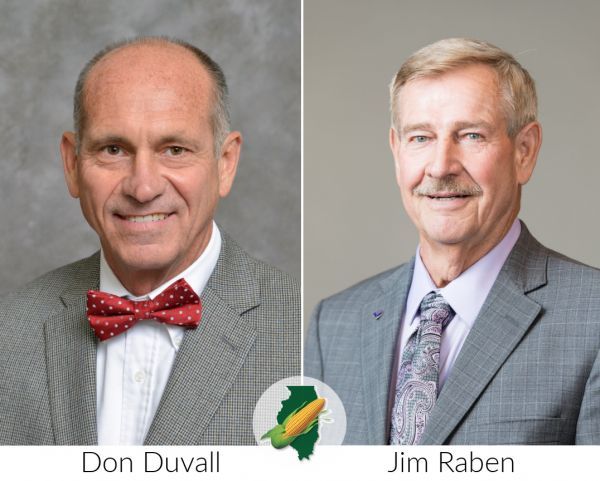
Don duvall and jim raben are standing next to each other

The delegates of the U.S. Grains Council (USGC) elected Jim Raben, a farmer from Ridgway, IL representing the Illinois Corn Marketing Board (ICMB), as chairman of its Board of Directors at its 60th Annual Board of Delegates Meeting, held virtually on Tuesday.


Additionally, Don Duvall, a farmer from Carmi, IL who recently termed off of the ICMB, will begin as an At Large Director on the USGC Board of Directors. Both Duvall and Raben have served the ICMB as Chairman during their tenure.


“It’s always been my way to cultivate relationships because together we are stronger, our collective voices are heard more loudly, and we can work together to achieve our common goals,” Raben said in his incoming remarks.

“The Council works around the clock and around the globe to find and expand new pockets of demand for the products we offer. That’s why I’ve chosen for my theme Building Relationships, Building Trade.”


Raben has been working on his family farm since 1973, more recently with help from his two sons. He spent nine years on the Illinois Corn Marketing Board before joining the Council’s board in 2015 as an at-large member. Raben has also previously served as the Board liaison for various USGC Advisory Teams (A-Teams).


The delegates elected as secretary-treasurer Joshua Miller of the Indiana Corn Marketing Council. In addition to Duvall, Duane Aistrope, Iowa Corn Promotion Board; and Verity Ulibarri, United Sorghum Checkoff Program, were elected as at-large directors.

The logo for the u.s. grains council has a leaf on it.

The full USGC Board of Directors is now as follows:

  • Jim Raben, Illinois Corn Marketing Board - Chairman
  • Chad Willis, Minnesota Corn Research and Promotion Council - Vice Chairman
  • Joshua Miller, Indiana Corn Marketing Council - Secretary/Treasurer
  • Duane Aistrope, Iowa Corn Promotion Board - At-Large Director
  • Brent Boydston, Bayer Crop Science - At-Large Director
  • Don Duvall, Illinois Corn Marketing Board - At-Large Director
  • Greg Hibner, J.D. Heiskell Hawkeye Gold - Agribusiness Sector Director
  • Wayne Humphreys, Iowa Corn Promotion Board - Corn Sector Director
  • Jim Massey, United Sorghum Checkoff Program - Sorghum Sector Director
  • Tadd Nicholson, Ohio Corn Marketing Program, State Checkoff Sector Director
  • Rick Schwarck, Absolute Energy - Agribusiness-Ethanol and Co-Products Sector Director
  • Mark Seastrand, North Dakota Barley Council - Barley Sector Director
  • Verity Ulibarri, United Sorghum Checkoff Program - At-Large Director
  • Ryan LeGrand, U.S. Grains Council - President and CEO


Outgoing Chairman Armstrong said in remarks to the delegates that the Council is fortunate to have many qualified individuals passionate about the agricultural industry in leadership positions at the Council.


“Our new chairman, the Board of Directors and the Board of Delegates provide excellent insight into the challenges and opportunities in the international trade arena,” Armstrong said.


The Council’s meeting continues Wednesday with Advisory Team meetings in the morning and a closing general session in the afternoon, featuring presentations by U.S.-China Business Council President Ambassador Craig Allen and former Assistant Trade Representative Sharon Bomer Lauritsen.


More from the meeting is available on social media, using the hashtag #grains20.


The U.S. Grains Council develops export markets for U.S. barley, corn, sorghum and related products including distiller’s dried grains with solubles (DDGS) and ethanol. With full-time presence in 28 locations, the Council operates programs in more than 50 countries and the European Union. The Council believes exports are vital to global economic development and to U.S. agriculture’s profitability. Detailed information about the Council and its programs is online at www.grains.org.

Lou Lamoreux Farm
By Tara Desmond September 3, 2026
Livestock farmer Lou Lamoreux talks about his farming operation.
captain Cornelius at shake it up cocktail lounge
By Tara Desmond September 3, 2026
4.29M bushels of U.S. corn fueled beverage alcohol production in July 2026 alone — up 54% from July 2025. Corn's in your Labor Day toast!
aerial view of short corn
By Tara Desmond September 3, 2026
Illinois farmer Steve Fourez tests short stature corn against conventional hybrids, exploring yield potential and late-season management benefits.
USDA building
By Lyndi Allen September 3, 2026
This week, U.S. Secretary of Agriculture Brooke L. Rollins announced the U.S. Department of Agriculture (USDA) Data Modernization Plan to put Farmers First, reduce unnecessary burdens on producers, and improve the timeliness, accuracy, and usefulness of the data that informs agricultural decisions. USDA data informs crop and livestock estimates, risk-management tools, disaster assistance, and critical business decisions made by farmers, ranchers, agribusinesses, researchers, and policymakers. In February 2026, Secretary Rollins issued a Request for Information seeking feedback on the opportunities, challenges, and emerging areas in USDA data. That feedback helped shape the USDA Data Modernization Plan and its four pillars: Modernize the Data Reporting Experience: USDA will expand use of administrative data, improve mobile access to surveys, explore opportunities to use prefilled information where appropriate, and strengthen coordination across the Department. These changes will reduce duplicative requests and limit the amount of time producers spend reporting information. Enhance Acreage and Yield Estimation: USDA will conduct a pilot to evaluate the use of improved satellite imagery, geospatial tools, crop models, and other emerging technologies combined with essential producer-reported information to enhance acreage and yield estimations. USDA will also assess the use of optional field inputs to enhance and ground truth yield estimates and continue advancing yield research through collaboration with agricultural partners and land-grant universities. Integrate Data and Technology Platforms: USDA will modernize its technology infrastructure, expand secure data-sharing capabilities, and evaluate the responsible use of tools such as artificial intelligence and machine learning. Better integrated systems will improve efficiency, reduce duplication, and allow USDA to produce more timely and useful information. Expand Trust and Transparency with Producers: USDA will protect producer privacy, clearly explain why information is requested and how it is used, and create additional opportunities for producers to provide feedback. USDA will also improve communication surrounding reports, methodologies, response rates, and data limitations. USDA will begin implementing actions under the plan immediately and will continue engaging farmers, ranchers, and agricultural stakeholders throughout the process. The Department will evaluate new approaches carefully, protect privacy and confidentiality, and publish clear methodologies and supporting information to maintain the integrity of USDA’s agricultural statistics. See USDA’s Full Data Modernization Plan
Cornfield beside a dirt path under a blue sky with wispy clouds
By Lyndi Allen September 2, 2026
EPA has granted 1.76 billion RIN exemptions to small refiners, raising concerns among farmers and biofuel producers about the potential impact on demand for renewable fuel.
Weekly News
By Lyndi Allen August 28, 2026
News from IL Corn for week ending 8/28/26
Show More