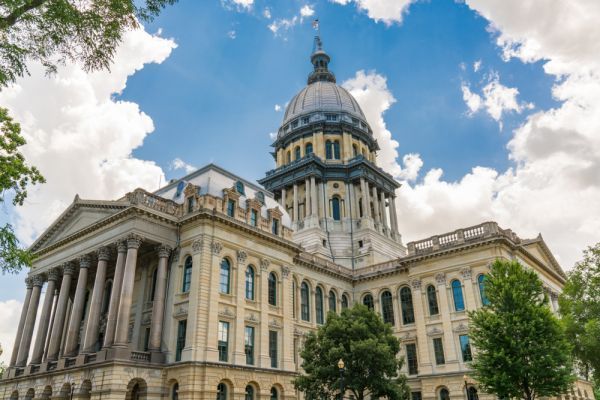
Senate President Don Harmon was reelected as Democrats continue to control the Illinois General Assembly with veto proof majorities in both chambers. The 102nd General Assembly consists of 41 Democrats to 18 Republicans in the Senate, and 73 Democrats to 45 Republicans in the House. Senate Republicans selected Senator Dan McConchie to replace retired Senator Bill Brady as their caucus leader. House Republicans voted to retain Representative Jim Durkin as their caucus leader.
Like everyone else, lawmakers are trying to figure out how to carry out their legislative responsibilities during the COVID pandemic. Speaker Welch said he would be reviewing ways to safely return to session as quickly as possible. He indicated that the House is discussing a hybrid model for remote committee hearings and in person floor action.
This lame duck session was unlike others as lawmakers pushed a 764-page bill written by the Black Caucus. Lawmakers worked all-night to get the bill passed and it is now headed to Gov. J.B. Pritzker. The primary issues included in the bill are:
- Economic Access, Equity, and Workforce Development
- Health Care and Human Services Reforms
- Education Reforms
- Criminal Justice Reforms, Violence Reduction and Police Accountability
Ethics Reform Legislation was introduced during the last days of the session addressing various issues but was not called for a final vote prior to adjournment. Various aspects of the bill addressed issues of legislators becoming lobbyists (“revolving door” reforms) and lobbying by local governments.
Other Issues Considered but not passed:
- EPA Permitting Changes-As part of the Environmental Justice discussion that would have affected numerous activities, including agriculture.
- Lead water service line replacements funding
- Farmer Equity Act – Proposed study to look at land ownership and economics related to Black farmers, disparities, economic issues, disadvantages in agriculture.
- Cannabis Equity Commission – issuances of licenses for cannabis facilities for minorities.
- Pay Day Loan businesses, effects on minorities.
- Ability to do remote legislating during emergencies like the COVID-19 Pandemic.
- Decoupling from Federal Tax laws related to federal CARES Act. (will be considered in new session)
Leadership
Speaker Welch announced his leadership team that is both racially and geographically diverse. Please see the list below:
- State Rep. Greg Harris - Majority Leader
- State Rep. Jehan Gordon-Booth - Deputy Majority Leader / Speaker Pro-Tempore
- State Rep. Mary E. Flowers - Deputy Majority Leader and Dean of the Caucus
- State Rep. Jaime M. Andrade, Jr. - Assistant Majority Leader
- State Rep. Robyn Gabel - Assistant Majority Leader
- State Rep. Elizabeth Hernandez - Assistant Majority Leader
- State Rep. Jay Hoffman - Assistant Majority Leader
- State Rep. Natalie Manley - Assistant Majority Leader
- State Rep. Marcus C. Evans, Jr. - Assistant Majority Leader
- State Rep. Delia Ramirez - Assistant Majority Leader
- State Rep. Carol Ammons - Democratic Conference Chair
The speaker also announced leaders within each caucus of the House Democratic delegation to serve as a caucus whip. Please see the list below:
- State Rep. Will Guzzardi - Progressive Caucus Whip
- State Rep. Kam Buckner - Black Caucus Whip
- State Rep. Theresa Mah - Asian Caucus Whip
- State Rep. Larry Walsh, Jr. - Downstate Caucus Whip
- State Rep. Deb Conroy - Women’s Caucus Whip
- State Rep. Aaron Ortiz - Latinx Caucus Whip
House Republican Leader Jim Durkin announced his leadership team. Please see the list below:
- Representative Dan Brady, Deputy Minority Leader
- Representative Tom Demmer, Deputy Minority Leader
- Representative Tom Bennett, Assistant Minority Leader
- Representative Avery Bourne, Assistant Minority Leader
- Representative Tim Butler, Assistant Minority Leader
- Representative C.D. Davidsmeyer, Assistant Minority Leader
- Representative Deanne Mazzochi, Assistant Minority Leader
- Representative Ryan Spain, Assistant Minority Leader
- Representative Keith Wheeler, Assistant Minority Leader
- Representative David Welter, Republican Conference Chair
- Representative Mark Batnick, Floor Leader
2021 Key Session Dates
January 29 - House Legislative Reference Bureau Request Deadline
February 5 - Senate Legislative Reference Bureau Request Deadline
February 11- Deadline for introduction of substantive House bills
February 17 - Governor’s State of the State and Budget Address
February 19 – Deadline for introduction of substantive Senate bills
February 23 - Consolidated Primary Election
March 26 – Deadline for substantive bills out of committee/both chambers
March 29 - April 9 - Spring Break
April 6 - Consolidated Election
April 23 – Deadline for third reading of substantive bills in both chambers
May 14 – Deadline for substantive bills out of committee in opposite chamber/both chambers
May 28 – Deadline for third reading of substantive bills in both chambers
May 31 - Adjournment