Virtual Opportunities Increase Interest in International DDGS Purchases

September 17, 2020
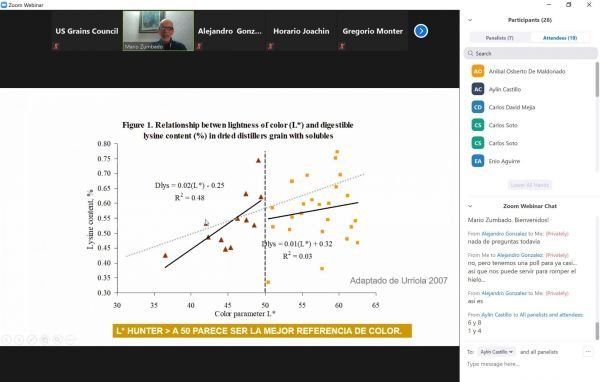
A computer screen with a graph on it

Beef and dairy cattle, swine and poultry can all benefit from U.S. distiller’s dried grains with solubles (DDGS) in their feed rations, but the feed ingredient can be hard to purchase and store in smaller quantities for small- to medium-sized producers in Central America. To address these logistical needs and discuss the advantages of DDGS, the U.S. Grains Council (USGC), funded by the Illinois corn checkoff, teamed up with a U.S. exporter for a recent webinar series.


DDGS, a secondary product created in the production of ethanol, is an important livestock feed that adds value to ethanol production. Given the state of the ethanol industry in the U.S., increasing access and international demand for DDGS can help ethanol plants and corn farmers in Illinois.

The Council conducted weekly webinars from mid-August to early September for interested producers in Guatemala, Honduras, El Salvador, Costa Rica and Nicaragua. Each session included a nutritionist with experience formulating or investigating DDGS usage for each species. The presentation detailed the nutritional benefits of DDGS, recommended inclusion rates and other relevant technical considerations.


More than 260 attendees tuned in for the webinar series – 41 percent for the poultry sessions, 32 percent for dairy and beef cattle and 27 percent for swine. The exporter reported that inquiries for DDGS by invited customers increased after the event.


“The virtual setting was important for reaching a broader base of producers,” said Ana Ballesteros, USGC marketing director for Latin America. “According to reports and surveys after the event, the Council achieved its goal of increasing awareness and interest in DDGS.”


The United States exported 320,000 metric tons of DDGS to Central America in the 2018/2019 marketing year with more room to grow. To realize this potential, the Council will continue to provide technical information about DDGS and partnered with regional players who can meet the specific logistical needs of small- to medium-sized producers.


The Illinois corn checkoff’s mission is to strategically invest funds to grow demand, create new markets, and foster understanding of corn farmers and the corn industry.

Baby with Corn Plastic Food Containers
By Pearl McDade June 12, 2026
Explore how corn is converted into PLA bioplastic for cups, food packaging, and 3D printing as demand grows for sustainable materials.
PCMthumbnail
By Tara Desmond June 11, 2026
PCM's 2026 Data Book, featured in this week's Prairie Farmer, shares 11 years of field data proving conservation and profitability go hand in hand.
By Tara Desmond June 11, 2026
How much do you know about the farmers who came before you and the decisions that still shape Illinois agriculture today? That's what University of Illinois student Lyndon Shi set out to explore during his internship with IL Corn . What began as an archival research project became a deeper look at the history of farmer leadership, innovation and advocacy in Illinois. While digging through university archives, Lyndon uncovered an undigitized manuscript from agricultural economist Harold Guither explaining the case for checkoffs. When he mentioned the discovery to IL Corn Director Rod Weinzierl, he got an unexpected response: "Oh yeah, I know him. We worked with him." It was a reminder that agricultural history isn't as distant as it may seem. Lyndon's research connected two eras of the IL Corn Growers Association: the original organization founded in the 1890s and the modern ICGA established in the 1970s. He learned how University of Illinois agriculture dean Eugene Davenport helped organize corn growers and sent professors across the state on "Corn Gospel Trains" to share the latest farming research. One story stood out in particular: the adoption of hybrid corn. Farmers who once judged corn by the appearance of the ear had to shift their focus to yield. Lyndon sees a similar transition today, as farmers increasingly balance yield with profitability amid rising input costs. "Illinois corn farmers are very good at organizing, and they are genuinely very grassroots," Lyndon said. "They've had a much more active role in shaping policy rather than just being on the receiving end." This Summer and Fall, Lyndon will travel to Taiwan on a federal scholarship to study food security. He'll do so with a new appreciation for Illinois agriculture's global connections, including Taiwan's longstanding role as an important trading partner. Watch the full conversation on IL Corn TV to hear Lyndon's research firsthand and discover how Illinois corn's history continues to influence the future.
Matt at USAPEEC Strategic Conference
By Tara Desmond June 11, 2026
IL Corn director Matt Raben was elected to USAPEEC's executive committee at the organization's 37th Annual Meeting this week.
Green world map with black curved arrows linking North America to Europe and Asia
By Lyndi Allen June 11, 2026
As one of the nation’s top agriculture exporters, Illinois ships corn to buyers across the globe—but where is it all going
Brian
By Tara Desmond June 11, 2026
Funk's Farm manager Brian Bangert explains the farm's 200-year history, the origins of Funk's G Hybrid, and how corn powers their cattle operation today.
Show More