
What Does a Cover Crop’s Carbon Really Cost? New PCM Data Puts a Number on It
By Summary from PCM / Farmdoc Webinar • October 8, 2026
Farmers hear about new conservation payment programs every year, with payments for cover crops, reduced tillage and nitrogen management. What has been harder to pin down is what those practices actually cost the farmer. A recent farmdoc webinar used field-level data from IL Corn’s Precision Conservation Management (PCM) program to answer that question.
Laura Gentry, Director of Water Quality Science at IL Corn, and Dr. Saurav Raj Kunwar, an agricultural economist at Texas Tech University, presented the findings. Kunwar developed the analysis with a University of Illinois research team.
The traditional view
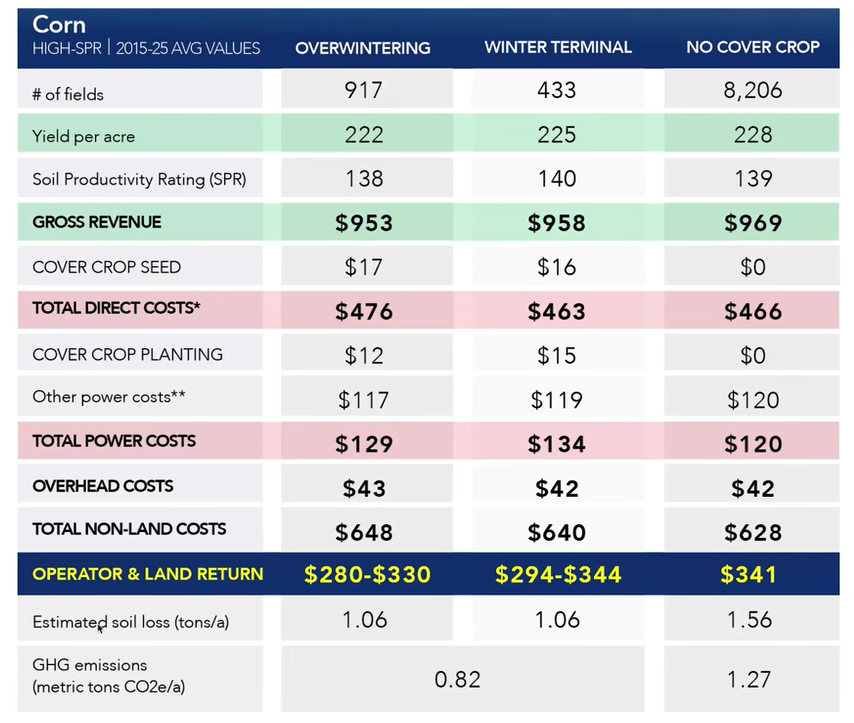
Gentry opened with the way PCM has reported cover crop economics to farmers for 11 years. On high-productivity Illinois corn fields, the average operator and land return was:
- $341 per acre for fields without a cover crop
- $319 for winter-terminal cover crops
- $305 for overwintering cover crops
Most of the gap comes from slightly lower yields, along with added seed, termination and machinery costs. The environmental benefits were also clear. Cover-cropped fields lost roughly half a ton less soil per acre and showed meaningful reductions in net greenhouse gas emissions.

A sharper measure
The new analysis treats cover crops as a technology the farmer pays for and asks a direct question: what is the minimum payment a farmer would need to provide carbon services and be no worse off?
Using 2021 data from 793 Illinois corn fields, the researchers put that cost at $27.30 per acre. The data came from 159 growers across 46 counties and about 51,700 acres. The total breaks into two parts:
- $17.88 for storing additional soil carbon. Cover-cropped fields already stored far more carbon than other fields, 0.55 versus 0.12 tons CO₂e per acre. Each additional gain therefore requires more costly management changes.
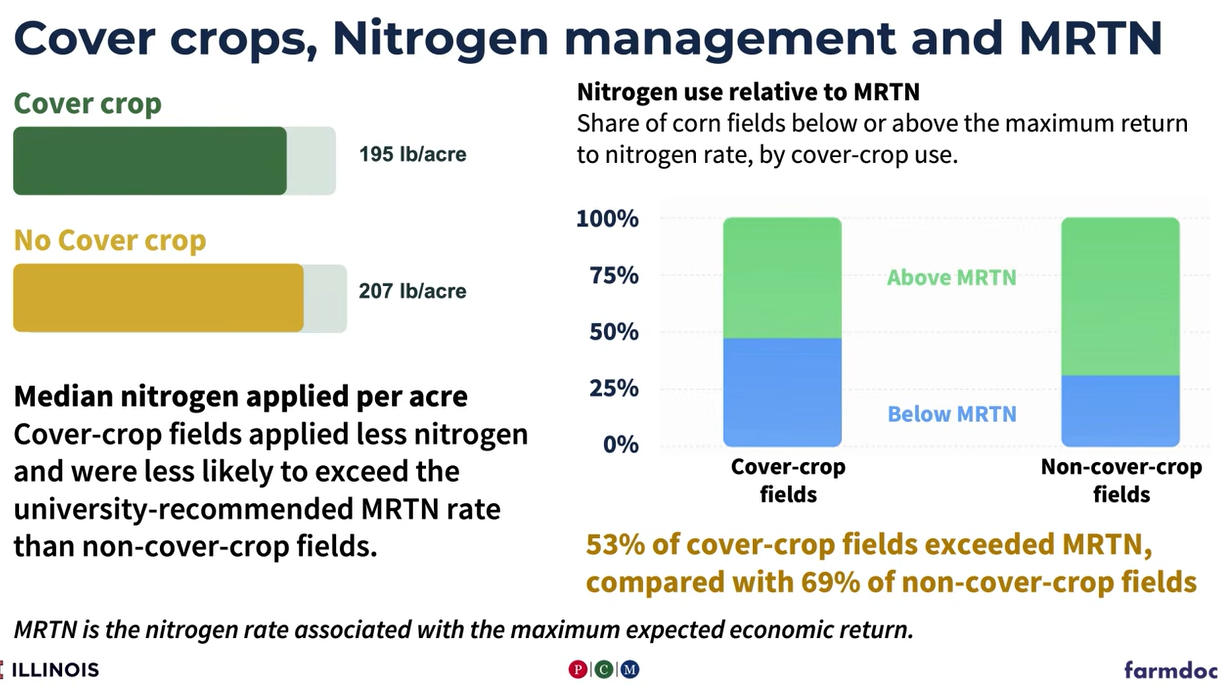
- $9.42 for reducing greenhouse gas emissions. Cover crop fields already used less nitrogen, with a median of 195 lb versus 207 lb. They were also less likely to exceed the MRTN, at 53% versus 69%. That leaves fewer low-cost cuts available.
The data also confirmed a pattern PCM has seen for years. About 86% of cover-cropped fields also used conservation tillage, compared with about 70% of all fields.
How payments stack up
Gentry compared the estimate with real programs:
- USDA’s Farmers for Soil Health program pays $35 an acre over three years.
- PCM’s private-sector partners, including PepsiCo, Kraft Heinz and the Kentucky Distillers Association, pay $15 per acre in years one and two and $10 after that.
- Those partner payments can be stacked with tillage and nitrogen practices for up to $35 an acre.
- Partner payments come with simple, single-year contracts. Those partners claim the carbon asset in return.
Gentry noted that farmers may reasonably carry some of the cost themselves, because healthier soil builds the long-term value of their own land. On rented ground, she said, the farmer and landowner should discuss how to share that cost.
The fine print
Kunwar stressed the limits of the estimate. It covers one year and one crop, and it draws on volunteer growers farming less than 1% of Illinois acres. It also captures only the farmer’s private cost for carbon services. The value of reduced erosion, better soil structure and lower nutrient loss is not included.
The method itself can be applied to other practices, states and years. Valuing those additional benefits is a logical next step, and that work could help shape how future conservation incentives are designed.
Watch full webinar.
American Journal of Agricultural Economics Journal