In the past week, the IL Corn Growers Association, National Corn Growers Association, and your farmer leaders have engaged in an overwhelming amount of E15 negotiations, conversations, and education. Where does our work put Illinois corn farmers today? Here’s a check in!
Timeline:
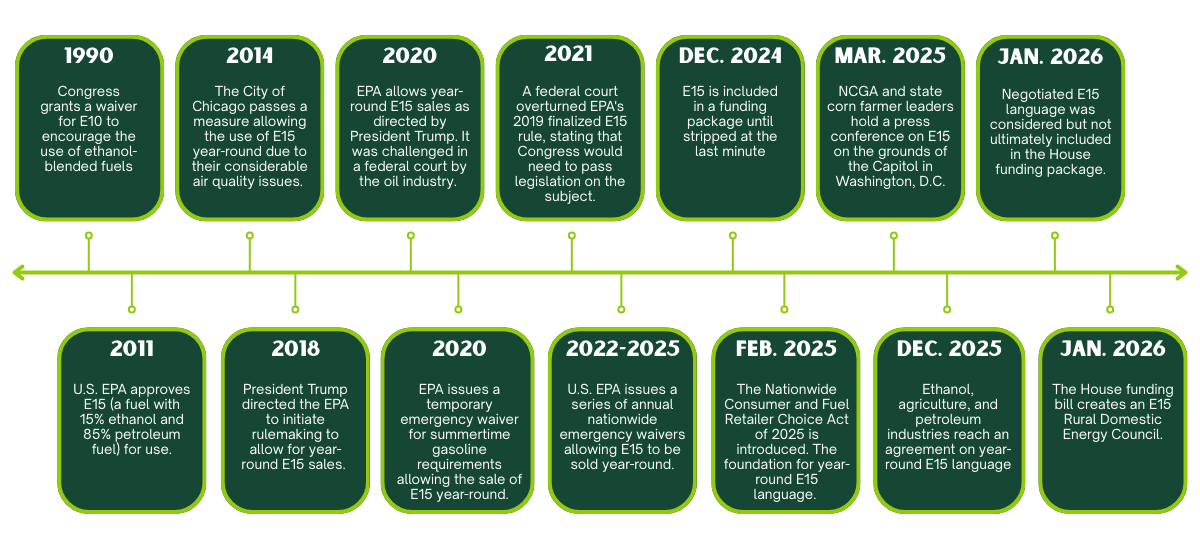
1990: Congress grants a waiver for E10 to encourage the use of ethanol-blended fuels.
2011: U.S. EPA approves E15 (a fuel with 15% ethanol and 85% petroleum fuel) for use.
2014: The City of Chicago passes a measure allowing the use of E15 year-round due to their considerable air quality issues.
2018: President Trump directed the EPA to initiate rulemaking to allow for year-round E15 sales.
2019: The EPA finalized the rulemaking to allow year-round E15 sales as directed by President Trump. The rule was challenged in a federal court by the oil industry.
2020: U.S. EPA issues a nationwide temporary, emergency waiver of the summertime gasoline requirements allowing for the sale of E15 year-round.
2021: A federal court overturned EPA's 2019 finalized E15 rule, stating that Congress would need to pass legislation on the subject.
2022-2025: U.S. EPA issues a series of annual nationwide emergency waivers allowing E15 to be sold year-round.
December 2024: E15 is included in a funding package until stripped at the last minute.
February 2025: The Nationwide Consumer and Fuel Retailer Choice Act of 2025 is introduced into the 119th Congress. This bill becomes the foundation for year-round E15 language.
March 2025: NCGA and state corn farmer leaders hold a press conference on E15 on the grounds of the Capitol in Washington, D.C.
December 2025: Ethanol, agriculture, and petroleum industries reach an agreement about year-round E15 language, as requested by the administration. This language is a modification of the Consumer and Fuel Retailer Choice Act introduced in February 2025.
January 2026: Negotiated E15 language was considered but not ultimately included in the House funding package.
January 2026: The House funding bill creates an E15 Rural Domestic Energy Council.
What’s the state of E15 today?
Last week, instead of including the agreed upon E15 policy language in the funding bill, the U.S. House of Representatives created an E15 Rural Domestic Energy Council. The members of this council have been instructed to negotiate an E15 policy amenable to all parties, submit the ideas by February 15, and Congress is to consider the language by February 25, 2026.
Unfortunately, state and national corn grower associations are in a challenging position on the issue. For fifteen years, we have been negotiating language with ag, ethanol, and petroleum interests in pursuit of year-round E15 policy we can all agree with. The language considered by the House last week was a negotiated position that more than 90% of the interests could support.
“Pursuit of perfection has gotten in the way of the achievable good,” said Rodney Weinzierl, IL Corn Growers Association Executive Director and farmer from Stanford, IL. “If Congress believes they can negotiate a bill that brings in the remaining 10% of interested parties, I believe they could negotiate out other key members, causing other debate and different unhappy constituents. We have two choices here: we can make solid progress for most impacted Americans, or we can pursue perfection and leave out everyone.”
As the newly created E15 Rural Domestic Energy Council begin negotiations, they must be mindful not to alienate groups like the American Soybean Association who were in a neutral position on last week’s language. The point of contention is small refinery exemptions (SREs) – an opportunity for some fuel refiners to opt out of renewable fuel blending requirements. Making significant changes to the SRE policies will impact biodiesel use requirements; however, refineries with problems about the proposed SRE language made up the opposition that kept year-round E15 out of last week’s bill.
Who is helping Illinois farmers?
Illinois has had strong involvement and support from our entire delegation during the debate of the funding bill last week. In the republican-led Congress, the voices of our three Republican members, Reps Bost, LaHood, and Miller, were most impactful with Speaker Johnson. Several Democrat members of the Illinois delegation were also publicly vocal about Illinois farmers’ need for increased ethanol demand, including Reps Budzinski, Sorensen, and Kelly.
Now, with the establishment of an E15 Rural Domestic Energy Council in the U.S. House, we understand that Reps LaHood and Bost have requested to participate. Reps Budzinski, Sorensen, Kelly, and Krishnamoorthi have also expressed interest in a seat on the council, but Democrat participation in a Republican-led initiative is unlikely.
The IL Corn Growers Association remains on the forefront of this issue.
Thank you to the Illinois corn farmers who contacted your Senators and Representatives last week, asking for their vote to include E15 in the final funding package.
Need to learn more?
The sale of E15 remains banned during the summer months to meet federal clean air standards based on the volatility of the blended fuel, quantified by reid vapor pressure or RVP. The fuel becomes more stable as the percentage of ethanol in the fuel increases; thus, E15 is more stable than E10.
Illinois enjoys 13 ethanol plants, with 25 percent of Illinois corn being sold into the Illinois ethanol industry. These ethanol plants represent 11.4 billion in economic impact for Illinois.
ICGA Statement on E15, Jan 22, 2026
Only Congress Can Fix the E15 Barrier, January 2026
The Case for E15, by the National Corn Growers Association, October 2025