In the past week, the IL Corn Growers Association, National Corn Growers Association, and your farmer leaders have engaged in an overwhelming amount of E15 negotiations, conversations, and education. Where does our work put Illinois corn farmers today? Here’s a check in!
What’s the state of E15 today?
This week, the year-round E15 has been taken out of the Farm Bill to be voted on as a separate piece of legislation during mid-May. The text was agreed upon by members of the E15 Rural Domestic Energy Council. The legislation is expected to be put back into the Farm Bill before going to the Senate, pending its passage in the House.
Lawmakers will vote on legislation to deliver a permanent, nationwide fix that would allow uninterrupted access to E15 throughout the summer months. This approach would replace the current system of temporary emergency waivers with long-term certainty for farmers, fuel retailers, and consumers.
In recent years, the U.S. Environmental Protection Agency has issued annual summer waivers to allow E15 in the marketplace, including a waiver for the 2026 driving season. While these actions have prevented supply disruptions and helped lower fuel costs, they are not a substitute for permanent policy. Retailers remain hesitant to invest in infrastructure, and farmers are left without the market certainty needed to plan for the future.
The opportunity now is clear: move beyond temporary fixes and deliver a nationwide, year-round E15 solution.
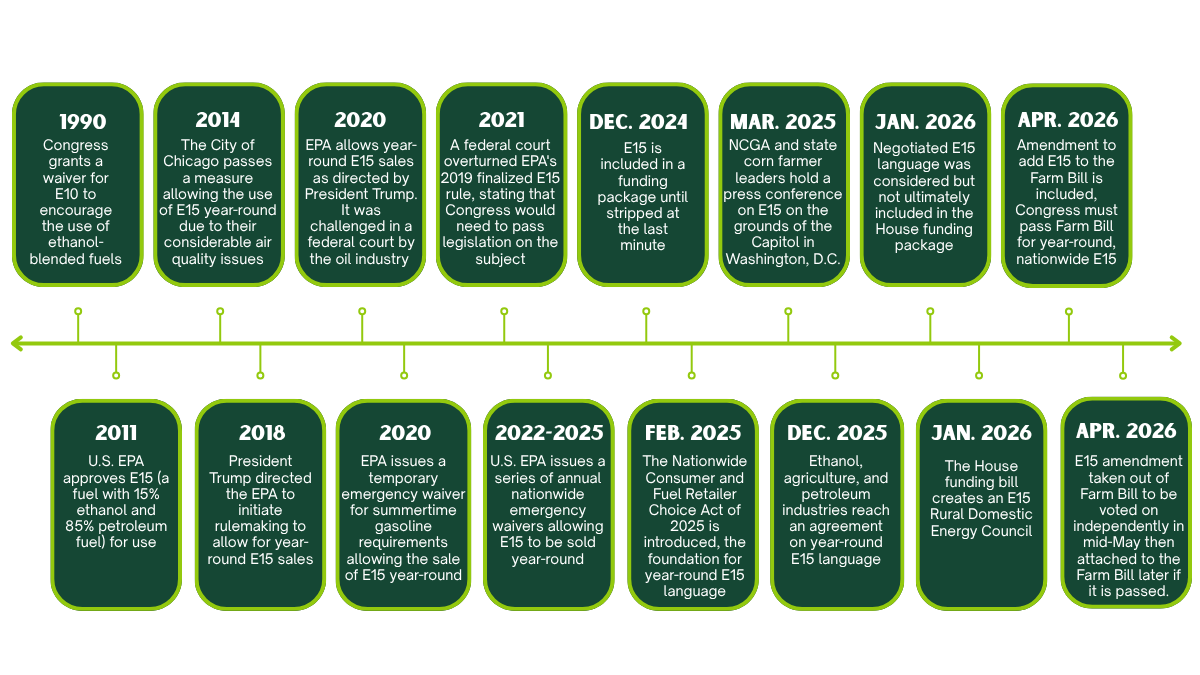
Timeline:
1990: Congress grants a waiver for E10 to encourage the use of ethanol-blended fuels.
2011: U.S. EPA approves E15 (a fuel with 15% ethanol and 85% petroleum fuel) for use.
2014: The City of Chicago passes a measure allowing the use of E15 year-round due to their considerable air quality issues.
2018: President Trump directed the EPA to initiate rulemaking to allow for year-round E15 sales.
2019: The EPA finalized the rulemaking to allow year-round E15 sales as directed by President Trump. The rule was challenged in a federal court by the oil industry.
2020: U.S. EPA issues a nationwide temporary, emergency waiver of the summertime gasoline requirements allowing for the sale of E15 year-round.
2021: A federal court overturned EPA's 2019 finalized E15 rule, stating that Congress would need to pass legislation on the subject.
2022-2025: U.S. EPA issues a series of annual nationwide emergency waivers allowing E15 to be sold year-round.
December 2024: E15 is included in a funding package until stripped at the last minute.
February 2025: The Nationwide Consumer and Fuel Retailer Choice Act of 2025 is introduced into the 119th Congress. This bill becomes the foundation for year-round E15 language.
March 2025: NCGA and state corn farmer leaders hold a press conference on E15 on the grounds of the Capitol in Washington, D.C.
December 2025: Ethanol, agriculture, and petroleum industries reach an agreement about year-round E15 language, as requested by the administration. This language is a modification of the Consumer and Fuel Retailer Choice Act introduced in February 2025.
January 2026: Negotiated E15 language was considered but not ultimately included in the House funding package.
January 2026: The House funding bill creates an E15 Rural Domestic Energy Council.
April 2026: Amendment to add E15 to the Farm Bill is included, Congress must pass Farm Bill for year-round, nationwide E15.
April 2026: E15 amendment taken out of Farm Bill to be voted on independently in mid-May then attached to the Farm Bill later if it is passed.
Who is helping Illinois farmers?
Illinois farmers are not alone in pushing for year-round E15—support is building across Congress, federal agencies, and industry leaders, particularly through the Farm Bill process.
Members of Congress from Illinois, Reps. Sorensen and Budzinski in particular, have supported this legislation aimed at securing permanent, nationwide access to E15. These efforts reflect a growing recognition that E15 is critical to strengthening domestic fuel supply, lowering costs for consumers, and expanding markets for corn growers.
Need to learn more?
The sale of E15 remains banned during the summer months to meet federal clean air standards based on the volatility of the blended fuel, quantified by reid vapor pressure or RVP. The fuel becomes more stable as the percentage of ethanol in the fuel increases; thus, E15 is more stable than E10.
Illinois enjoys 13 ethanol plants, with 25 percent of Illinois corn being sold into the Illinois ethanol industry. These ethanol plants represent 11.4 billion in economic impact for Illinois.
ICGA Statement on E15, Jan 22, 2026
Only Congress Can Fix the E15 Barrier, January 2026
Oil Corporations Attempt to Derail Legislation That Lowers Fuel Prices by National Corn Growers Association, April 2026