
From Fields to Foam: How Corn Shows Up in Your Soap


By Pearl McDade June 25, 2026

Illinois corn powers renewable soap ingredients, from foaming cleansers to starches, oils, and ethanol.

How is corn used in soap? 

Instead of relying on synthetic or petroleum-derived chemicals, modern soap manufacturers have turned to corn. Corn serves as the backbone for biodegradable, plant-based cleansers, with a variety of uses including moisture retention, gentle exfoliation, and even pH balance.


Currently, the bio-based cleaning market is booming. This change comes as 78% of consumers prefer sustainable cleaning products. As major brands like Procter & Gamble, Unilever, and Colgate-Palmolive Co. publicly commit to lofty sustainability goals, these products are becoming more important than ever. 


For example, the alkyl polyglucoside (APG) market stands at $1.77 billion in 2026 and is projected to reach $3.9 billion by 2036. APGs are a corn-derived foaming ingredient that serve as an alternative to fossil fuel derived surfactants. They are widely used for baby soaps, facial cleansers, and hand soaps because they are gentle and biodegradable. 


In other cases, soap production uses more common corn-based products like corn starch, citric acid, and ethanol. 


How does corn become a cleanser? 

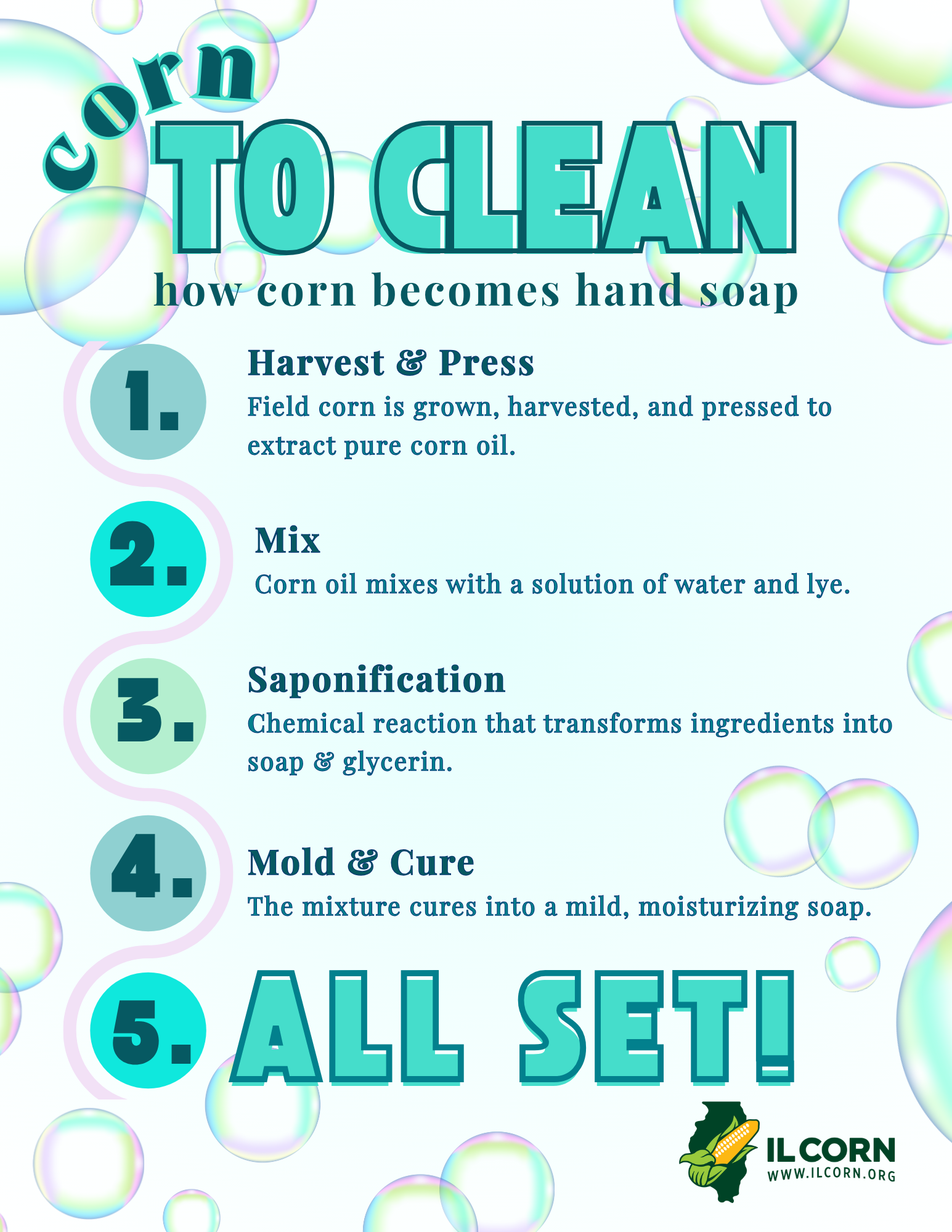
  • Corn Oil: Corn oil can be used as the base oil in the saponification process. This contributes to soap with a thick lather. However, it is often mixed with harder oils like coconut oil. 


While this is just one way that corn finds itself in soap, some hand soaps contain up to 25% ingredients that were derived from corn. Here's a look at a few of these uses: 


  • Cornmeal: Ground corn is used as a natural exfoliant in many soaps. 
  • Cornstarch: Cornstarch is used in many commercial soaps and laundry detergents to help bind ingredients and absorb moisture. 
  • Corn Silk: Threads from corn silks are steeped in hot lye water, melting into the liquid to add a silky texture to the soap. If you want to try it out, look here
Corn to clean infographic with 5 teal steps for making hand soap, on a bubble background
  • Citric Acid: Citric acid is used to adjust the pH balance and soften hard water. It's often fermented from corn, with a 54% market share, creating a market of $0.86 billion in 2024. 
  • Ethanol: Ethanol, produced from corn starch, acts as a natural solvent and sanitizing agent in liquid soap. 


Why use corn-based soap?

  • 100% Biodegradable: Corn-based additives break down safely in waterways without toxic residues. 
  • Mild on skin: Corn-derived oils and sugars create a very gentle lather, making it a great choice for sensitive skin and baby soaps. 
  • Replaces petroleum: The use of corn swaps out fossil-fuel based surfactants and preservatives for a renewable, home-grown alternative. 
  • Low environmental impact: Corn-based surfactants like APGs emit less greenhouse gases, are non-toxic to aquatic life, and demonstrate degrade by 70% in just 28 days.


To browse soaps and cleaning products that use corn-based additives, visit EWG's guide:


Sources:

https://www.grandviewresearch.com/industry-analysis/clean-beauty-market-report 

https://consumerbrandsassociation.org/wp-content/uploads/2020/06/Top-25_Sustainability-Commitments.pdf 

https://www.factmr.com/report/747/alkyl-polyglucoside-market#:~:text=Report%20Summary%20of%20Alkyl%20Polyglucoside,2.12%20billion%20in%20absolute%20opportunity

https://www.barentz-na.com/en/us/hii/Blog/apg-industrial 

https://ndcorncouncil.org/wp-content/uploads/2021/03/Common-Items-Containing-Corn-1.pdf 

https://cosmileeurope.eu/inci/detail/17072/zea-mays-kernel-meal/ 

https://candlesandsupplies.com/how-to-make-cornsilk-soap/?srsltid=AfmBOoryM0iin7yvlRycatSL7aFyWX_IPKs7BQBxFvpPEmL8wFCo_aIk 

https://www.ars.usda.gov/news-events/news/research-news/2007/cornstarch-yields-eco-friendly-laundry-ingredient/ 

https://www.strategicmarketresearch.com/market-report/citric-acid-non-gmo-market 

https://www.anecochem.com/news/alkyl-polyglucoside-apg-surfactants-types-and-industrial-uses 


Not a member?

Become one today!

SHARE THIS

Latest Posts

Monarch butterfly perched on a green plant against a blurred grassy background
By Pearl McDade June 25, 2026
Support pollinators in Illinois schools with free milkweed seeds, hands-on STEM learning, and real-world agriculture and conservation lessons.
Matt Raben
By Lyndi Allen June 25, 2026
Illinois Corn Farmer, Matt Raben, Speaks Out on the Importance of U.S. Mexico Canada Agreement (USMCA) for Agriculture by sharing U.S. corn export numbers to Canada and Mexico
Flags of Canada, the United States, and Mexico waving against a blue sky
By Lyndi Allen June 24, 2026
The U.S. – Mexico – Canada Agreement (USMCA) has been delivering real results for American families, farmers, and businesses since 2020.
shane and Andrew on il corn tv
By Tara Desmond June 18, 2026
What Illinois Farmers Should Know About the People Opening Global Doors for Their Grain
agronomy angle
By Matt from Becks June 18, 2026
Fungicide Timing and Today's Disease Challenges
milkdonation
By Tara Desmond June 18, 2026
In honor of National Dairy Month, Illinois farmers and IL Corn helped deliver thousands of pounds of milk to food-insecure families.
Evan Leeper
By Lyndi Allen June 17, 2026
Meet Evan Leeper, a fifth-generation farmer working ground in Macon County that his family has farmed since the 1850s. A former infantryman who farms alongside his father and brother-in-law.
U.S. Department of Agriculture Building
By Lyndi Allen June 17, 2026
U.S. Secretary of Agriculture Brooke Rollins announced a historic $125 million annual investment in agricultural research infrastructure across America, an opportunity for Illinois Universities
Baby with Corn Plastic Food Containers
By Pearl McDade June 12, 2026
Explore how corn is converted into PLA bioplastic for cups, food packaging, and 3D printing as demand grows for sustainable materials.
PCMthumbnail
By Tara Desmond June 11, 2026
PCM's 2026 Data Book, featured in this week's Prairie Farmer, shares 11 years of field data proving conservation and profitability go hand in hand.
Show More